Graves' Disease in Children: About a Case
Allouane Mohamed Amine, Laababsi Rabii, El Krimi Zineb, Rouadi Sami, Abada Reda Lah, Roubal Mohamed, Mohamed Mahtar
Citation : Amine AM, Rabii L, Zineb EK, Sami R, Lah AR, Mohamed R, Mahtar M, Graves' Disease in Children: About a Case. Asclepius Med Case Rep 2018;1(1):1-3.
Graves' disease is an autoimmune disease featuring hyperthyroidism associated with exophthalmos. It is a rare affection in pediatrics, found mostly in older children. The diagnosis of Graves' disease is quite easy. The treatment, however, often requires a multidisciplinary approach and an extended medical follow-up. We relate the case of Graves' disease diagnosed in a 12-year-old girl, revealed by an anterior cervical tumefaction associated with proptosis, who received surgical treatment with a good evolution.
Graves' disease, hyperthyroidism, pediatrics, thyroidectomy
INTRODUCTION
Graves' disease, also known as toxic diffuse goiter, is the most common etiology of hyperthyroidism in children. It is an autoimmune disorder, of which the cause is still undetermined.
Its positive diagnosis is often easy to make, when confronted with the association of typical symptoms and perturbed thyroid hormones.
It is important to note that Graves' disease can be potentially life threatening. As such, it is imperative to start treatment as soon as the diagnosis is made. Although anti-thyroid drugs are usually used first, surgical treatment remains a nonnegligible therapeutic component in many situations.
CASE REPORT
It is about a 12-year-old girl, without any prior medical condition, who presents with an anterior cervical mass. The beginning of the symptoms date back to 1 year when she noticed the appearance of an anterior basicervical painless swelling, growing progressively, without compressive signs, associated with palpitations, abundant sweating, asthenia, and a decline in her studies.
The clinical examination finds a patient in a good condition. Her height, weight, and body mass index were normal according to her age. Her blood pressure was normal, and her heart rate was a little elevated at 110 bpm.
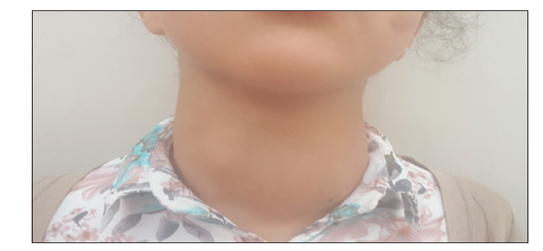
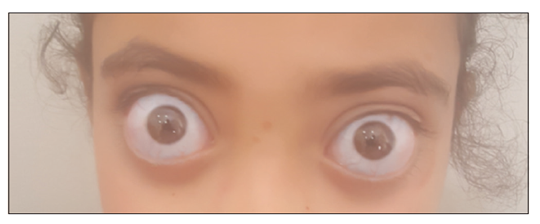
We note the presence of a goiter affecting all of the thyroid gland, firm, measuring 5 cm X 7 cm (Figure 1), and a symmetric, bilateral exophthalmos, with no inflammatory signs (Figure 2).
Thyroid function tests showed:
- TSH = 0.001 µUI/mL
- T4 = 49.13 pmol/L
- T3 = 30 pg/mL
- TSH receptor antibodies are not realized by lack of means.
Thyroid ultrasound revealed a hypertrophied, homogenous, and hypervascularized thyroid.
Other tests, including a full blood count and an ECG, were normal.
A treatment based on Dimazol was initiated but without improvement. The patient then underwent a total thyroidectomy. Euthyroidism was only obtained after surgery (TSH = 0.2 µUI/mL).
DISCUSSION
Graves-Basedow disease is an autoimmune thyroiditis originating from the production of thyroid-stimulating immunoglobulins, which bind to TSH receptors, leading to the overproduction of thyroid hormones.
It constitutes the first etiology of hyperthyroidism in pediatrics but is still a quite rare disease. Indeed, of all the cases of Graves' described in the literature, only 1-5% are children [1].
Its frequency increases with age, with an average age of 11 years in most of the published series [2-5]. In our case, the patient was 12 years old, which is consistent with the literature data. There is a clear feminine preponderance, reported by several authors [3-5].
The etiopathogenesis of Graves' is not yet well known. It associates genetic, immunological, and environmental factors [6]. Familial thyroid dysfunction is found in 60% of the cases [7]. In our case, there was no history of dysthyroidism in the family.
The classic symptoms' triad: Tachycardia, nervousness, and vascular goiter, presents in 90-95% of all cases,[8-11] associated to a symmetric and bilateral proptosis, and makes the diagnosis of Graves' disease easy. This triad, as well as the proptosis, was both observed in our patient.
Other symptoms (diarrhea, thermophobia, weight loss...) may be present, although less frequently.
Elevated thyroid hormones (T3 and T4), associated with low TSH levels and positive thyroid-stimulating antibodies, confirm the diagnosis. Thyroid ultrasound reveals a hypertrophied gland, homogenous, and hypervascularized, and can be useful in long-term follow-up of the patient. Scintigraphy is no longer needed for the diagnosis and has been replaced with thyroid ultrasound[12].
The management of Graves' disease in children in still controversial. Three options seem available: Medical treatment based on antithyroid drugs (ATDs), surgery (total or subtotal thyroidectomy), and radioiodine therapy. Medical treatment is recommended as the first-line treatment [7,12]. ATD works by blocking the binding of iodine and coupling of iodothyronines, thus preventing the synthesis of thyroid hormones. The main ATDs used are carbimazole (0.5-0.8 mg/kg/day), methimazole (0.5-0.8 mg/kg/day),[13] and propylthiouracil (5-10 mg/kg/day). After normal levels of thyroid hormones are obtained, ATD doses are gradually decreased by 30-50%.
During the initial phase of treatment, adjuvant therapy may be started to control symptoms, mainly a beta-blocker to regularize the heart rate, and a sedative to manage the nervousness and agitation [7,14].
The average period of treatment by ATD is 2-6 years [12]. The patient's adherence to this long-term treatment is of paramount importance in its success and in the prevention of a relapse. The main complication of ATD is agranulocytosis, which requires regular monitoring of the blood count.
Total thyroidectomy is indicated in case of failure of medical treatment (relapse after ATD treatment, lack of adherence to the treatment, or ATD toxicity). It is particularly recommended in case of a voluminous goiter or severe ophthalmopathy [15]. In the case of our patient, surgical treatment was undertaken after the failure of medical treatment.
ATD treatment will be started first, to obtain normal T3, T4, and TSH levels before surgery. To reduce the vascularization of the thyroid, the patient may be given iodine (5-10 drops of Lugol) in the week preceding the surgery.
In comparison to ATD treatment and radioiodine therapy, surgical treatment by total thyroidectomy has the clear advantage of quickly reducing hyperthyroidism.
The main complications of surgical treatment are the lesion of the recurrent nerves and that of the parathyroids.
Radioiodine therapy is only indicated in case of failure of medical treatment and an absolute contraindication to surgery. Destruction of the thyroid gland is obtained in most cases after only one oral dose. However, this treatment modality is associated with a moderated risk of aggravation of the ocular signs of Graves' and should be avoided when treating children because of the potential risk of developing an ulterior neoplasm.
In case of radical treatment, be it by surgery or by radioiodine therapy, the patient will need to be put under thyroid replacement pills or levothyroxine, for the rest of his life.
CONCLUSION
Graves' disease is a rare condition in pediatrics, most often affecting the female older child with a background of familial dysthyroidism.
The diagnosis is easy, as the symptomatology is usually quite rich and the biological assessment is typically disturbed.
Medical treatment by ATD is the first-line treatment. In case of failure, surgery should be considered. Radioiodine therapy is a third treatment option that should be left as a last resort.
REFERENCES
- Abraham-Nordling M, Bystrom K, Torring O, Lantz M, Berg G, Calissendorff J, et al. Incidence of hyperthyroidism in Sweden. Eur J Endocrinol 2011;165:899-905.
- Boiko J, Leger J, Raux-Demay MC, Cabrol S, Le Bouc Y, Czernichow P, et al. Childhood Graves' disease: Clinical and evolutionary aspects. Arch Pediatr 1998;5:722-30.
- El Ghissassi N, Bouvard V, Benbrahim-Tallaa, Guha N. Childhood Graves' disease: Clinical, evolutionary and therapeutic aspects, about 17 observations. Ann Endocrinol 2012;73:307-8.
- Chemli J, Abdennebi H, Zorgati M. Child's graves' disease in the tunisian center: Clinical and evolutionary study of seven observations. Rev Maghreb Pediatr 2003;13:211-20.
- Merad MS, Manz MG, Karsunky H, Wagers A, Peters W. Hyperthyroidism in children and adolescents: Clinical, evolutionary and therapeutic aspects. Ann Endocrinol 2013;74:369.
- Franklyn JA, Boelaert K. Thyrotoxicosis. Lancet 2012;379:1155-66.
- Czernichow P. Hyperthyroidie et Hypothyroidie de L'enfant. Paris: Encycl Med Chir (Elsevier, Paris), Encyclopedie Pratique de Medecine, 8-0580; 1998. p. 6.
- Perelman R. Maladie de Basedow. La Medecine Infantile; 1985.p. 435-3.
- Thibaut H, Clausse MD, Brauner R. Treatment of hyperthyroidism in children with anti-thyroid drugs. Ann Pediatr (Paris) 1993;40:341-7.
- Hazard J, Perlumeter L. Hyperthyroidie: Physiopathologie: Pathogenie de la maladie de Basedow. Abreges D'endocrinologie. 3rd ed. Masson: EDItEUR; 1990. p. 150-3.
- Leger J, Kaguelidou F, Alberti C, Carel JC. Graves' disease in children. Best Pract Res Clin Endocrinol Metabol 2014;28:233-43.
- Perrild H, Gruters-Kieslich A, Feldt-Rasmussen U, Grant D, Martino E, Kayser L, et al. Diagnosis and treatment of thyrotoxicosis in childhood. A European questionnaire study.Eur J Endocrinol 1994;131:467-73.
- Bahn RS, Burch HB, Cooper DS, Garber JR, Greenlee MC, Klein I, et al. Hyperthyroidism and other causes of thyrotoxicosis: Management guidelines of the American thyroid association and American association of clinical endocrinologists. Endocr Pract 2011;17:456-520.
- Lee JA, Grumbach MM, Clark OH. The optimal treatment for pediatric Graves' disease is surgery. J Clin Endocrinol Metab 2007;92:801-3.