Familial Mediterranean Fever Presenting with Acute Intestinal Obstruction -
A Case Report
Ahamed Faiz Ali, Ashraf K, Sunil Kumar, Loutfi.G W Elsokary, Amar N
Citation : Ahmed faiz ali et.al., Familial Mediterranean Fever Presenting with Acute Intestinal Obstruction-A Case Report. Asclepius Med Case Report 2018;1(1):1-3.
Familial Mediterranean fever (FMF) is one of the types of hereditary periodic fever syndrome. It is characterized by recurrent attacks of febrile polyserositis, most commonly peritonitis. Abdominal symptoms are characterized by signs of peritonitis and sometimes present with features of acute appendicitis. Abdominal pain occurs in 95% of all patients with FMF and 30-40% of patients undergo unnecessary surgical interventions. We report a case of a 6-year-old male child with FMF, presenting with symptoms of abdominal pain and vomiting. Initially, the child was treated conservatively by a pediatrician and later referred to a pediatric surgeon when the clinical condition worsened. Before this, the child had similar episodes and was managed conservatively by the pediatrician. On examination, the child had features of acute intestinal obstruction which did not improve over 24 h and needed exploratory laparotomy. This case report suggests that in an FMF patient with recurrent abdominal pain, surgical abdomen should not be arbitrarily excluded from the differential diagnosis. Therefore, abdominal pain should be carefully determined according to the clinical condition of the patient.
Familial mediterranean fever, acute intestinal obstruction, laparoscopyn
INTRODUCTION
Familial Mediterranean fever is one type of hereditary periodic fever syndrome. Abdominal symptoms accounts for 95% of all patients. When atypical pain fails to resolve spontaneously or persistent the surgeon should consider the diagnosis of intestinal obstruction due to adhesive bands.
Yalcinkayer et al. proposed another set of criteria for pediatric FMF but are limited to single ethnic group, were MEFV mutations in both alleles [4].
FMF abdominal pain is very similar to a surgical acute abdomen. However, symptoms characteristically resolve spontaneously within 48-72 h. Abdominal pain can be localized or diffuse from the start. This pain may be due to peritoneal inflammation or due to adhesions. Self-resolving peritonitis is the most common clinical feature of FMF. However, repeated attacks of peritonitis may result in the formation of peritoneal adhesions that may cause adhesive bowel obstruction requiring urgent surgical intervention [2].
Abdominal pain in FMF patients should be carefully evaluated according to the clinical features of the patient. It is estimated that 30-40% of patients underwent unnecessary surgical intervention such as appendectomy, cholecystectomy, and negative laparotomy [3]. In FMF patients, other causes of gastrointestinal manifestation are episodic abdominal pain, side effects of colchicine, gastrointestinal amyloidosis, vasculitis, inflammatory bowel disease, diarrhea, constipation, paralytic ileus, or mechanical ileus [4, 6]. When atypical pain fails to resolve spontaneously or is persistent, the surgeon must consider the diagnosis of intestinal obstruction due to adhesive bands. Failing to recognize this may result in strangulation or gangrene of bowel. Therefore, this life-threatening surgical emergency should be kept in mind in the differential diagnosis of acute abdomen of FMF. There should not be any delay in exploration, if surgical diagnosis of intestinal obstruction is clearly established [5].
CASE REPORT
A 6-year-old Egyptian male child with known case of Familial Mediterranean fever (FMF) presented to us with 3 pres history of fever, abdominal pain, and vomiting. He was diagnosed with FMF for 3 rnces. He had a family history of FMD from maternal side. He was managed with colchicine in the past for abdominal pain. After a period of observation, fever subsided, but abdominal pain and vomiting persisted. Abdominal pain was initially confined to the upper abdomen, later became generalized. Vomiting was initially non-bilious, later progressed to be bilious in nature.
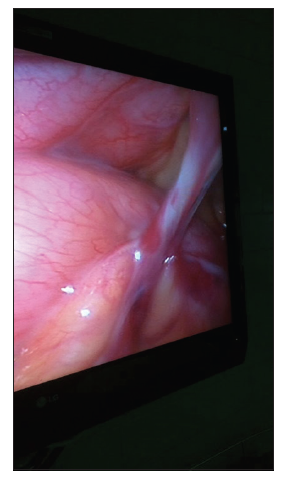
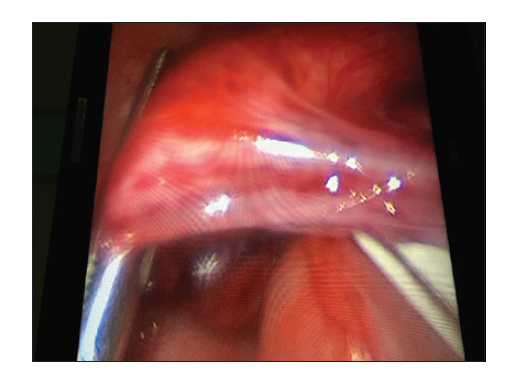
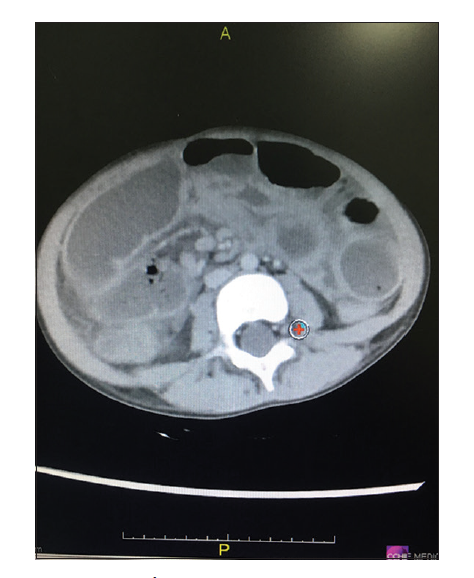
On examination, he was afebrile and moderately dehydrated. His abdominal examination showed features of generalized peritonitis. His blood workup showed white blood cells 8.4 X 10⁹L, hemoglobin 12.3g/dL, platelet 350,000, procalcitonin 1.7, and C-reactive protein 48. Serum electrolytes showed hyponatremia with hypokalemia. Abdominal X-ray showed multiple fluid levels suggestive of intestinal obstruction. Ultrasound done showed dilated small bowel loops and no intra-abdominal collection. Computed tomography (CT) abdomen and pelvis showed diffusely distended small bowel loops with multiple fluid levels and mild bowel wall thickening. Disparity of bowel lumen diameter was noted at distal ileum (level of obstruction) with multiple mesenteric adenitis. There were no intra-abdominal collection and no radiological evidence of appendicitis or cholecystitis. Official CT report was that of intestinal obstruction.
Since the clinical condition did not improve over 24 h, he underwent explorative laparoscopy. Intraoperative findings showed three inflammatory adhesive bands between the ileal loops causing intestinal obstruction. One was at the level of the terminal ileum and others are at 10 at and 15 15 proximally to the first one. These bands were released laparoscopically. The post-operative course was uneventful.
DISCUSSION
(A) One or more major criteria or 2 minor criteria, (B) 2 or more major criteria or 1 major plus 2 minor criteria, (C) 2 or more criteria.
FMF is a hereditary autosomal recessive autoinflammatory disorder characterized by recurring and self-limiting attack of febrile serosal inflammation [1]. It usually involves the peritoneal, synovial, and the pleural membrane. It is commonly found in Armenians, Turks, Arabs, Balkans, and Jews originating from North African countries.
Representative diagnostic criteria for FMF:[4]
A. Livneh FMF diagnostic criteria
- Major criteria
- Peritonitis (generalized)
- Pleuritis (unilateral) or pericarditis
- Monoarthritis (hip, knee, and ankle)
- Fever alone
- Minor criteria
- Incomplete attacks affecting one or more sites
- Abdomen
- Chest
- Joint
- External leg pain
- Response to colchicine.
B. Sohar criteria
- Major criteria
- Recurrent febrile episodes with serositis
- Amyloidosis of amyloid A type without predisposes disease
- Response to colchicine
- Minor criteria
- Recurrent febrile episodes
- Erysipelas-like erythema
- Family history in the first-degree relative.
C. Yalcinkaya criteria for pediatric patients
Fever axillary temperature 38°C duration 6-72 h and more than three attacks:
- Abdominal pain duration 6-72 h and three attacks
- Chest pain duration 6-72 h and more than three attacks
- Arthritis duration 6-72 h attacks and oligoarthritis
- Family history of FMF.
References
- Ciftci AO, Tanyel FC, BFC, B FC, B N, Hi, B FC A. Adhesive small bowel obstruction caused by familial Mediterranean fever: The incidence and outcome. J Pediatr Surg 1995;30:577-9.
- Annunzia D. Pitfalls in FMF-acute obstruction due to primary adhesion. J Visceral Surg 2011;148:217-9.
- KaaKa217- T, Cansu DU, Korkmaz C. Frequency of abdominal surgery in patients with familial Mediterranean fever. Intern Med 2009;48:523-6.
- Sakurai Y, Murata T, Hirata H, Morita T. Acute appendicitis in 14 Sakus old boy with Mediterranean fever. J Pediatr Surg Case Rep 2015;3:4-6.
- Tal Y, Berger A, Abrahamson J, Horowitz I, Winter ST. Intestinal obstruction caused by primary adhesions due to familial Mediterranean fever. J Pediatr Surg 1980;15:186-7.
- Mor A, Gal R, Livneh A. Abdominal and digestive system associations of familial Mediterranean fever. Am J Gastroenterol 2003;98:2594-604.