On Healing Powers: Asclepius, Caduceus and Antibodies
Noah Isakov
Citation : Isakov N. On Healing Powers: Asclepius, Caduceus and Antibodies. Asclepius Med Case Rep 2018;1(1):1-4.
Asclepius was a much-worshiped healing deity in the Greek mythology that represents a number of healing aspects of the ancient medical arts [1, 2]. Although in Homer's Iliad Asclepius was related to as a human being physician who treated soldiers at the battle of Troy, during the time of Hippocrates Asclepius was elevated to the status of an immortal god, the god of medicine.
Asclepius was the son of a divine father, Apollo, and a mortal mother, Coronis, and is therefore considered a demigod [3]. The myth emphasizes Asclepius' duality as a human being and a deity; he could miraculously eliminate pain, relieve maladies, and heal sick people, thanks to his divine heritage, but he also performed advanced surgical procedures and developed healing skills and powers through knowledge, experience, and wisdom [4].
Asclepius was married to Epione, the daughter of Hercules, and the goddess of the soothing of pain, and the couple had nine children, to which they have passed different healing powers [5]. Their five daughters included Hygeia, the goddess of health, cleanliness, and sanitation (hygiene); Laso, the goddess of recuperation from illness; Aceso, the goddess of the healing process; Aglaea, the goddess of the beauty and the glow of good health; and Panacea, the goddess of universal remedy. In addition, Asclepius had four sons, two of which, Podalirius and Machaon, were legendary healers who served as surgeons and medics during the Trojan War [5].
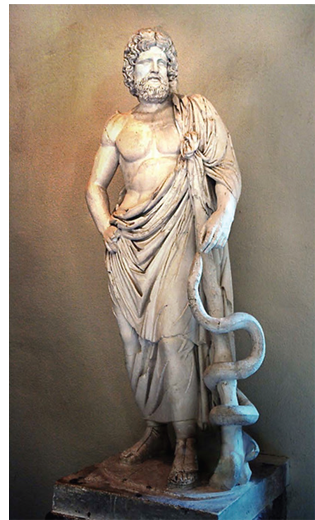
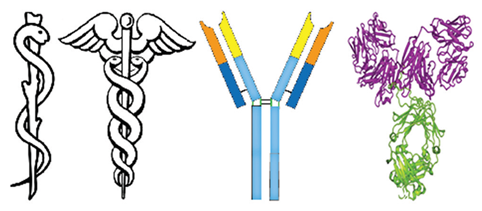
Many healing temples were constructed in Old Greece in honor of Asclepius, specifically for the purpose of medical care, representing the very first hospitals [6]. The most significant Asclepius' healing sanctuary was constructed in Epidaurus (the sanctuary of Asklepios), at the Peloponnesus peninsula, in the 6th century BCE [7,8]. This sanctuary, together with the sanctuaries of Zeus at Olympia and Apollo at Delphi, is among the most impressive sacred sites of ancient Greece. Asclepius was almost always depicted as a middle-aged man holding a rod (or staff) with a single serpent encircling it [Figure 1] [4]. The Rod of Asclepius (also termed Asklepian) represents the physician's healing authority, while the snake venom, which might be poisonous but could also hold medicinal properties, represents the dual nature of the physician's work, involving sickness and health, or life and death. It is a reminiscent of Tai-Chi (taiji) in the Chinese philosophy, in which the two opposite, but complementary forces of nature, the yang and yin, are interconnected [9]. This ancient emblem of healing power serves also as a classic symbol of medicine in modern times and was adapted by the World Health Organization [Figure 2], as well as many other medical associations worldwide.

The Rod of Asclepius is frequently confused with the caduceus,[10] a somewhat similar ideogram, which is also derived from the Greek mythology, but with no connection to healing powers or the art of medicine [11]. The caduceus is depicted as a short rod entwined by two serpents, instead of one serpent, sometimes decorated by two wings [Figure 3] [12]. The caduceus represents the rod of the Olympian God Hermes, the messenger of the Gods and the son of Zeus, and ruler of all gods at Mount Olympus. The caduceus is often incorrectly used as an insignia of the medical profession and as a symbol of health-care organizations, predominantly in North America, apparently due to confusion with the traditional emblem of the Rod of Asclepius [11].
The symbol containing the serpent-entwined rod was in use in different ancient societies and was also mentioned in the Bible, in the Book of Numbers 21:9. There, the biblical symbol, termed Nehushtan, was mentioned in connection with Moses who prepared a bronze-snake and attached it to a pole, to heal and protect the Israelites who were bitten by venomous snakes [13]. An even older symbol of snakes twining around an axial rod (and accompanied by two gryphons) is the symbol of the Sumerians god, Ningishzida, in ancient Mesopotamia, a deity of field and meadow and the underworld [14]. The actual significance of this symbol for the Sumerians and whether it represented healing powers are unclear.
One of the best, new-era analogs of the mythological rod of Asclepius is the antibody molecule, also termed immunoglobulin (Ig),[15] which, even though may be deprived of spiritual powers, has two unique characteristics which make it a superior healing and protecting protein.
The antibody molecule has a Y-shape structure consisting of four protein subunits, two identical heavy chains that are connected to each other through a disulfide bond, and two identical light chains, each associated with a single heavy chain through disulfide bonds. Antibodies are produced by B lymphocytes and are in charge of humoral immune responses, one of the two arms of the adaptive immune system.
The two powerful characteristics that enable the antibody to exhibit super-healing properties reside in the two opposite ends of the molecule [Figure 3]. The first characteristic, which enables antibodies to interact with millions of distinct antigen molecules, namely, the antigen binding site, is confined to the remote part of the two arms of the "Y," at the amino-terminus of the molecule, termed Fab (fragment antigen binding)[16]. This region is composed of hypervariable regions of a single heavy and a single light chain, and each antibody can mediate highaffinity interaction with only one type of antigen. The highly selective antigen-binding site is found in two identical copies in each immunoglobulin G (IgG), the most frequent antibody in our body.
Thanks to a unique molecular mechanism of somatic DNA rearrangement in the antibody-encoding genes, each of us possesses an extremely large number of different antibodies that vary in their hypervariable regions and ability to interact with unique target antigens. It is estimated that this number is at the range of 1012 different antibody molecules in the preimmune repertoire [17]. Our antibody repertoire is apparently large enough to ensure that every possible antigen that might enter the body will be encountered by at least one type of antibody.
The degree of heterogeneity of variable regions can further increase the following repeated exposures to an antigen, either by immunizations or due to repeated infections. Under such conditions, antigen-specific B lymphocytes undergo somatic hypermutation at the antigen-binding site, concomitant with affinity maturation, which results in the production of additional types of antibodies that bind their target antigens with a much higher affinity.
While antibody-mediated interaction with antigens is sufficient for neutralization of certain molecules, such as bacterial toxins, the majority of the biological activities of the antibodies are mediated through their carboxy-terminal region, the Fc (fragment crystallizable) portion of the heavy chain, which represents the second unique characteristic of the antibody molecule [18].
All human antibodies are grouped into five major subclasses, and all antibodies in each subclass possess one type of heavy chain that is characterized by a structurally and functionally unique Fc region. The different Fc regions can physically interact with an array of soluble molecules, such as components of the complement system, and with surface receptors specific for certain Fc regions, which are expressed on different hematopoietic cell populations. Antibodies that bind antigens through their antigen binding site and interact with Fc receptors on the surface of different cell types can signal the target cells to mediate a variety of functions, including engulfment, destruction, and digestion of particulate antigens, such as pathogens, virally-infected cells, and tumor cells. Furthermore, while antibodies mediate humoral immune responses, as part of the adaptive immune system, more recent studies demonstrated that the Fc region allows antibodies to link the adaptive and innate immune systems and enables cells of the innate immunity, which are devoid of antigen receptors, to respond in an antigenspecific manner [18]. Binding of the antibodies' Fc region to their cognate receptors on effector cells, such as neutrophils, macrophages, eosinophils, monocytes, mast cells, natural killer cells, and platelets, can activate these cells, direct them to the antigen-containing target organ or tissue, and promote their response against the specific antigen.
Antibodies are among the most versatile proteins in our body, thanks to the extremely large repertoire of their antigen binding sites, their ability to activate the complement system, and their ability to link functionally distinct hematopoietic effector cells to target antigens. Thanks to these properties, the antibody molecules defend our body from numerous types of distinct disease-causing agents and pathogens. Furthermore, the knowledge gained through scientific research on the antibody structure and function has helped the development of methods for monoclonal antibody production and antibody engineering technologies, which enable the construction of superior antibodies,[19,20] humanized recombinant antibodies,[20] and antibody-based chimeric antigen receptors [21]. These advancements led to the utilization of antibody molecules in an extremely wide range of diagnostic assays and clinical applications.
Throughout the years, many antibody preparations have gained the U.S. Food and Drug Administration approval and are being utilized as immunotherapeutic agents in a wide range of diseases. For example, anti-tumor necrosis factor (TNF) antibodies were shown to be of clinical benefit to rheumatoid arthritis patients, by inhibiting TNF-induced damages to joints and tissues and the associated painful symptoms [22]. Anti-Her2 (a certain type of epithelial growth factor (EGF) receptor) antibodies can block the propagation of various EGF-dependent cancer cells,[23] and anti-vascular endothelial growth factor (VEGF) antibodies were found to target blood vessels within tumors and inhibit the growth of cancer cells by reducing their oxygen supply [24]. Furthermore, anti-cytotoxic T lymphocyte-associated molecule-4 (CTLA-4) and antiprogrammed death-1 (PD-1) antibodies (anti-immune checkpoint receptor antibodies) were found to block negative signals provided by the cancer cells to T lymphocytes,[25] thereby augmenting anti-cancer T lymphocyte cytotoxic responses.
Recent years have shown a progress in antibody-mediated anti-cancer immunotherapy and selected cancer-specific antibodies have been found to improve the health of patients with certain types of malignancies.
Future advances in cancer immunotherapy rely on the identification and validation of new prognostic and predictive biomarkers for different types of cancers. Innovations leading to the development of personalized biomarker profiles and antibody-based treatment in combination with
other therapeutic modalities are likely to improve the leading path to increased therapeutic success across a whole range of tumor types.
ACKNOWLEDGMENT
I thank Ms. Caroline Simon for editorial assistance. Work in my laboratory was supported in part by the USAIsrael Binational Science Foundation, the Israel Science Foundation administered by the Israel Academy of Science and Humanities, and a donation by Mr. Martin Kolinsky. N.I. holds the Joseph H. Krupp Chair in Cancer Immunobiology.
REFERENCES
- Savel RH, Munro CL. From asclepius to hippocrates: The art and science of healing. Am J Crit Care 2014;23:437-9.
- Hart GD. Asclepius, god of medicine. Can Med Assoc J 1965;92:232-6.
- Edelstein L, Edelstein EJ. Asclepius: Collection and Interpretation of the Testimonies. Baltimore and London: The Johns Hopkins University Press; 1998.
- Jones KB. The staff of asclepius: A new perspective on the symbol of medicine. WMJ 2008;107:115-6.
- Panagiotidou O. Asclepius' myths and healing narratives: Counter-intuitive concepts and cultural expectations. Open Theol 2016;2:2300-6579.
- Yeo IS. The birth of hospital, asclepius cult and early christianity. Uisahak 2017;26:3-28.
- Rousselle R. Healing cults in antiquity: The dream cures of asclepius of epidaurus. J Psychohist 1985;12:339-52.
- Caton R. Two lectures on the temples and ritual of asklepios at epidaurus and athens: Delivered at the royal institution of great britain. Br Med J 1898;1:1509-13.
- Kuo S. Yin-Yang in Tai-Chi Chuan and Daily Life. North Atlantic Books. California: Berkeley; 2004.
- Nayernouri T. Asclepius, caduceus, and simurgh as medical symbols, part I. Arch Iran Med 2010;13:61-8.
- Lipsitt DR. Deception in medicine: Hermes or asclepius? J Nerv Ment Dis 2017;205:413-6.
- Parrish DO. The symbol of medicine: One snake, not two. JAMA 1989;261:3412.
- Goihman-Yahr M. Nehushtan: The pressing need. Int J Dermatol 2006;45:980-1.
- Frothingham AL. Babylonian origin of hermes the snake-god, and of the caduceus I. Am J Archaeol 1916;20:175-211.
- Glynn LE, Steward MW. Structure and Function of Antibodies. New York: John Wiley; 1980.
- Mian IS, Bradwell AR, Olson AJ. Structure, function and properties of antibody binding sites. J Mol Biol 1991;217:133-51.
- DeKosky B. Decoding the Antibody Repertoire. Cham: Springer Theses; 2017.
- Ackerman M, Nimmerjahn F. Antibody Fc. Linking Adaptive and Innate Immunity. Philadelphia, PA: Academic Press; 2013.
- Pento JT. Monoclonal antibodies for the treatment of cancer. Anticancer Res 2017;37:5935-9.
- Caron PC, Laird W, Co MS, Avdalovic NM, Queen C, Scheinberg DA, et al. Engineered humanized dimeric forms of igG are more effective antibodies. J Exp Med 1992;176:1191-5.
- Srivastava S, Riddell SR. Chimeric antigen receptor T cell therapy: Challenges to bench-to-bedside efficacy. J Immunol 2018;200:459-68.
- Dalum I, Butler DM, Jensen MR, Hindersson P, Steinaa L, Waterston AM, et al. Therapeutic antibodies elicited by immunization against TNF-alpha. Nat Biotechnol 1999;17:666-9.
- Yu S, Liu Q, Han X, Qin S, Zhao W, Li A, et al. Development and clinical application of anti-HER2 monoclonal and bispecific antibodies for cancer treatment. Exp Hematol Oncol 2017;6:31.
- Zielke A, Middeke M, Hoffmann S, Colombo-Benkmann M, Barth P, Hassan I, et al. VEGF-mediated angiogenesis of human pheochromocytomas is associated to malignancy and inhibited by anti-VEGF antibodies in experimental tumors. Surgery 2002;132:1056-63.
- Isakov N. Immune checkpoint-targeted therapy: Cancer and autoimmune diseases represent two sides of the same coin. J Autoimmune Disord 2016;2:1-4.