Necrotizing Scrotum Fasciitis (Fournier's Gangrene) in an Infant: A Case Report and Review of the Literature
Yasin Idweini
Citation : Idweini Y. Necrotizing scrotum fasciitis (Fournier's Gangrene) in an infant: A case report and review of the literature. Clinic Res Urol 2018;1(1):1-3.
Necrotizing fasciitis in infants is rare and is associated with almost 50% mortality. As originally reported, it was characterized by an abrupt onset of a rapidly fulminating genital gangrene of idiopathic origin in previously healthy young patients which resulted in gangrenous destruction of genitalia. Herein We report a case of necrotizing fasciitis in an infant, this patient was treated with debridement of his scrotum at presentation and subsequently reconstructed with his own remained scrotum by secondary intention, patient discharged alive and healthy.
Fasciitis, Fournier, infant
INTRODUCTION
Fournier's gangrene is a form of necrotizing fasciitis occurring about the male genitalia. It is also known as idiopathic gangrene of the scrotum, streptococcal scrotal gangrene, perineal phlegmon, and spontaneous fulminant gangrene of the scrotum [1,2]. As originally reported, it was characterized by an abrupt onset of rapidly fulminating genital gangrene of idiopathic origin in previously healthy young patients, which resulted in gangrenous destruction of the genitalia [3].
Jean Alfred Fournier, a French Venereologist, reported five patients with unexplained gangrene of the penis and scrotum in 1882.
Today, Fournier's gangrene refers to any gangrenous infectious process involving the external genitalia and perineum. It is a life-threatening infection, which may occur in only one or two patients a year in large city-county hospitals.
It is rarely idiopathic and often arises from an infection involving the urinary tract or from direct extension from a perirectal source. Physical examination is diagnostic. Early in the disease, physical findings may be limited to swelling and erythema of the penis and scrotum. As the disease progresses, crepitus may overlie the skin extending up the abdominal wall along the distribution of Colles' fascia and may extend to the axilla, thighs, or buttocks.
A foul, feculent odor is often present and indicates an anaerobic infection. Fever, chills, nausea, vomiting, malaise, or mental status changes may reflect sepsis [4].
Aggressive, empiric broad-spectrum intravenous antibiotics, including coverage of both aerobic and anaerobic organisms, and early wide surgical debridement are required,[5] because mortality from this infection sometimes approaches 50% [6]. It occurs at any age and has even been reported in a 4-monthold infant,[7] as in our case, and mean age was 54 years.
CASE REPORT
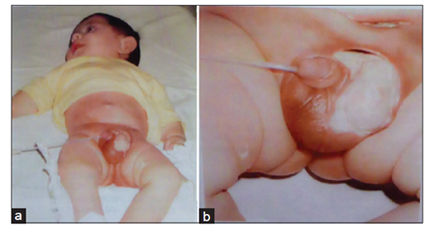
A 4-month-old male infant presented to the emergency room, referred from another hospital, with gangrenous left scrotum and distal part of the left inguinal region, with fever. Before that, the patient underwent left herniotomy, 2 days before. Moreover, on his examination, he was febrile, irritable child with necrotic patches on his left scrotum and distal part of his inguinal region, swelling of both scrotum and inguinal region with erythema. Serosanguinous exudate appeared from the herniotomy incision.
His laboratory results were within normal limits, except his leukocytosis.
Intravenous hydration and broad-spectrum antibiotics were started (third-generation cephalosporin with aminoglycoside and metronidazole).
Under general anesthesia, a Foley's catheter was left in the urethra and wide debridement of necrotizing tissue was performed. The left testicle was exposed; it was viable and covered by tunica vaginalis. Opening the wound of herniotomy, and the wound left opened [Figure 1]. Laboratory results of swab culture revealed B. haemolytic streptococci and E. Coli.
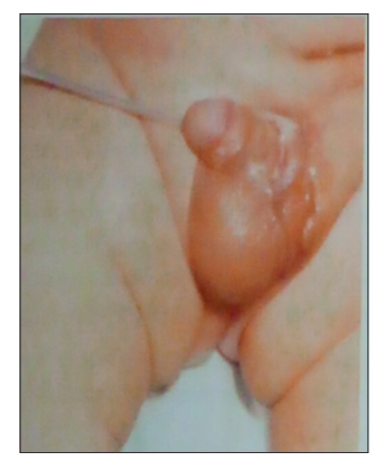
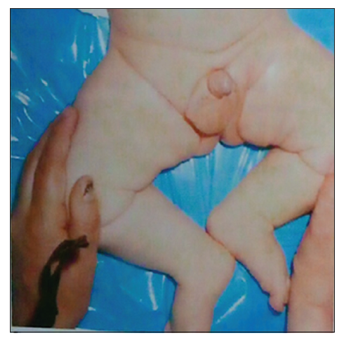
The patient was followed up by dressings and debridement of necrotic tissues under general anesthesia 1 week later [Figure 2], and after appearance of clean granulation tissue, the wound was closed by primary suturing, and then, the patient was discharged from the hospital [Figure 3].
DISCUSSION
Idiopathic gangrene of the scrotum is uncommon but fearful in effect. It is a vascular disaster of the infective origin. Infection most commonly arises from the skin, urethra, or rectal regions.
An association between urethral obstructions associated with structures and extravasation has been well documented, and predisposing factors include diabetes mellitus, local trauma, coital injury, insect bite, paraphimosis, periurethral extravasation of urine, perirectal or perianal infection, and surgeries, such as circumcision or herniotomy, as in our case report [8,9].
In cases originating in the genitalia, the infecting bacteria probably pass through buck's fascia of the penis and spread along the dartos fascia of the scrotum and penis, Colles' fascia of the perineum, and Scarpa's fascia of the anterior abdominal wall. Wound cultures generally yield multiple organisms, implicating anaerobic - aerobic synergy. Mixed cultures containing facultative organisms (E. coli, Klebsiella, and Enterococci) have been obtained from the lesions [10-12].
Aerobic and anaerobic organisms act synergistically to produce a progressive obliterative endarteritis, leading to vascular thrombosis and gangrene. The infection commonly starts as cellulitis adjacent to the portal of entry. At the beginning the involved area is swollen erythematous, and tender, and progressively the infection begins to involve the deep fascia, then pain is prominent, fever and systemic toxicity are marked [13] The swelling and crepitus of the scrotum quickly increase, and dark purple areas develop and progress to extensive gangrene.
Intravenous hydration and antibiotic therapy are indicated in preparation for surgical debridement.
Extensive incision should be made through the skin and subcutaneous tissues until normal fascia is found. Necrotic fat and fascia should be excised and the wound should be left open.
Orchiectomy is almost never required since the testes have their own blood supply, independent of the compromised fascia and cutaneous circulation to the scrotum. Suprapubic diversion should be performed in cases where urethral trauma or extravasation is suspected. Colostomy should be performed if there is colonic or rectal perforation [14].
Hyperbaric oxygen therapy has been shown promising in shortening hospital stay, increasing wound healing, and decreasing the gangrenous spread [13].
Once wound healing is complete, reconstruction, for example, using myocutaneous flaps, improves cosmetic results [15].
The mortality rate average is approximately 20% but ranges from 7% to 75%. Higher mortality rates are found in diabetics, alcoholics, and those with colorectal sources of infection who often have a less typical presentation, greater delay in diagnosis, and more widespread extension [12,16,17].
From 56 reported cases of Fournier's gangrene in children, 66% have been found in the first 3 months of life [18] The overall mortality rate is 23%. Variety of aetiology was, trauma, insect bite, circumscion, burns, perirectal disease and systemic infection [19,20].
The organisms isolated were streptococci and staphylococci rather than Gram-negative rods and anaerobes that predominate in adults.
The child's appearance is often deceiving and may appear a nontoxic, healthy child despite having fever, leucocytosis of gangrenous disease with local inflammation [21]
CONCLUSION
Fournier's gangrene is a true urologic emergency that demands early recognition, aggressive treatment with antibiotics, and surgical debridement to reduce morbidity and mortality.
Fournier's gangrene occurs at any age, even early childhood.
REFERENCES
- Fournier JA. Fulminant Gangrene of the penis. Semin Med 1883;3:345.
- Fournier JA. Clinical study of the fulminant gangrene of the penis. Semin Med 1884;4:69.
- Baurienne H. Cotused wound finished in scrotum gangrene. J Med Chir Pharm 1764;20:251.
- Spirnok JP, Resnick Ml, Hampel N, Persky L. Fournier's gangrene: Report of 20 patients. J Urol 1984;131:289-91.
- Kearney GP, Carling PC. Fournier's gangrene: An approach in its management. J Urol 1983;130:695.
- Papachristodonlon AJ, Zografos GN, Papastratic G, Papavassiliou V, Markopoulos CJ, Mandrekas D, et al. Fournier's gangrene still highly lethal, langenbecks. Arch Chir 1997;382:15.
- Soony CL, Whee LL. Scrotal gangrene in a 4-month old infant. Singapore Med J 1966;7:173.
- Laucks SS. Fournier's gangrene. Surg Clin North Am 1994;74:1339.
- Lowe FC. Gangrene of the male genitalia. In: Marshall FF, editor. Operative Urology. Philadelphia: WB Saunders; 1996.
- Meleney FL. A differential diagnosis between certain types of infectious gangrene of the skin, with particular reference to haemolytic streptococcal gangrene and bacterial synergistic gangrene. Surg Gynecol Obstet 1933;56:842.
- Miller JD. The importance of early diagnosis and surgical treatment of necrotizing fasciitis. Surg Gynecol Obstet1983;157:197-200.
- Cohen MS. Fournier's gangrene. AUA Update Ser 1986;5(6).
- Paty R, Smith AD. Gangrene and Fournier's gangrene. Urol Clin North Am 1992;1:149.
- Weiner DM, Lowe FC. Gangrene of the male genitalia. AUA Update Series Lesson no 6. Vol. 17. American Urological Association; 1998. p. 42-7.
- Wolach MD, MocDermott JP, De Vere white RW. Treatment and complications of Fournier's gangrene. Br J Urol 1989;64:310.
- Baskin LS, Carroll PR, Cattolica EV, Mc Aninch JW. Necrotizing soft tissue infections of the perineum and genitalia: Bacteriology, treatment, and risk assessment. Br J Urol 1990;65:524.
- Clyton MD, Fowler JE Jr, Sharifi R. Causes, presentation, and survival of 57 patients with necrotizing fasciitis of the male genitalia. Surg Gynecol Obstet 1990;170:49.
- Adams JR, Mata JA, Venable DD, Culkin DJ, Bocchini JA. Fournier's gangrene in children. Urology 1990;25:439-41.
- Sussman SJ, Schiller RP, Shashikumar VL. Fournier's syndrome in infants. Am J Dis Child 1978;132:189-91.
- Erbuomwan I, Aliu AS. Acute gangrene in a one month old child. Trop Geogr Med 1984;36:299.
- Heaman KF, Homann W. Pisark: Fournier's gangrene in a two month old Infant. Klin Padriatr 1984;196:392-3.