Risk Factors among Participants in a Community Health Worker Led Infant Mortality Prevention Home-visiting Program
Christine M. Swoboda, Ann Scheck McAlearney, Timothy R. Huerta
Citation: Swoboda CM, McAlearney AS, Huerta TR. Risk Factors Among Participants in a Community Health Worker Led Infant Mortality Prevention Home-visiting Program. J Community Prev Med 2018;1(1):1-7.
The purpose of this study was to compare the risk factors assessed by community health workers (CHWs) to those in birth records and Medicaid data to evaluate the risk factors for infant mortality among high-risk Black mothers enrolled in the OIMRI program.
OIMRI program data collected by CHWs were matched to birth records and Medicaid data for 2,812 participants between 2010 and 2015. Proportion tests, Chi-square tests, and confidence intervals were calculated to compare risk factors between time periods, datasets, and program participants and Black mothers in Ohio.
The most common risk factors included unwanted pregnancy, homelessness or poor living conditions, or other (including low income, low support, or stress). Mothers in OIMRI reported smoking, anemia, and no prenatal care in the first 3 months to CHWs at statistically significantly lower rates than were reported in birth record or Medicaid data. Compared to all Black mothers in Ohio, OIMRI participants were significantly more likely to smoke before and during pregnancy, use alcohol or drugs, be enrolled in women, infants, and children, or have a diagnosis or receive services for mental health disorders.
Participants in OIMRI had multiple risk factors for infant mortality; it is important that infant mortality prevention efforts similar to OIMRI intervene on high-risk women to efficiently focus their efforts.
Community health workers, infant mortality, maternal health, risk factors
INTRODUCTION
While some infant mortality is due to genetic causes, many leading causes of infant death have medical, behavioral, and environmental risk factors that can be managed to mitigate infant mortality risk[1,2] Maternal medical risks, which include hypertension and diabetes, can often be managed under the care of a physician[3-7] Behavioral risks, which include unplanned pregnancy, drug, alcohol, or tobacco use, poor nutrition, late or inadequate prenatal care, and stress, are harder to manage and can interact with environmental risks such as poverty, poor social support, and low food availability[8-15]. Mothers who live in poverty, or in low-income or highly segregated neighborhoods, may experience multiple risk factors simultaneously[16].
Taken together, these risk factors weigh more heavily on Black communities and the mothers within them. For instance, one of the greatest risk factors for infant mortality is preterm birth, and the rate of preterm birth among Black mothers is 73.1% in comparison with a rate for the population of 66.3%[7,17]. Similarly, Black mothers are likely to experience the risk factors of late or inadequate prenatal care, unintended pregnancy, stress, poverty, anemia, hypertension, and obesity more than other races[15,16,18]. Despite reductions in Black - White infant mortality rate disparities in some states, there is still a significantly higher infant mortality rate among Black infants that programs need to address[19].
In an attempt to address these risk factors among Black women in the State of Ohio, the Ohio Department of Health (ODH) created The Ohio Infant Mortality Reduction Initiative (OIMRI) in 1994[20]. The OIMRI program employs Community Health Workers (CHWs) who conduct home visits focused on mitigating the risk factors faced by Black women. CHWs are community members trained in an accredited program to act as public health workers who connect individuals who have traditionally lacked access to adequate care to care and support services.
As part of the OIMRI program, CHWs assess risk factors for participating pregnant women during the intake home visit through interviewing the participant and observing her home environment. These home visits take place in a participant's home or may occur at a shelter, public building, or the home of a friend or family member. Using this risk information, CHWs then attempt to tailor OIMRI program materials to address the risks that might contribute to poor birth outcomes. In this context, the ability of a CHW to accurately assess risk is crucial to program success. Yet prior research indicates that people underreport risk factors when self-reporting, and in cases where the effectiveness of the intervention depends on accurately assessing associated risks, the need for robust risk assessment is critical[21-23] As a result, there is a critical need to evaluate the accuracy and completeness of CHW risk assessments against objective data.
This paper evaluates the intake risk factor assessment conducted by OIMRI CHWs in comparison to data reported during prenatal clinic visits. Birth records and Medicaid data were used to corroborate the presence of similar risk factors as well as identify risks which were not included in the categories assessed by CHWs. As differences between risks identified by CHWs and those identified by medical personnel may represent unattended or mischaracterized needs among the population, the results of this study can inform future efforts that rely on subjective assessment of risk factors for infant mortality.
METHODS
Data from three sources were used in this study: OIMRI intake reports; Ohio Vital Statistics birth records; and the Ohio Medicaid Women of Reproductive Age dataset.First, OIMRI intake reports including data regarding intake date, risk factors, estimated weeks gestation at OIMRI intake, barriers to care, and recruitment method were obtained for 4,475 program participants. Risk factors were recorded by CHWs across 16 categories through interviewing participants about the presence of factors, an assessment of the mother's behavior, and an evaluation of her home environment. This list of risks was developed collaboratively by program administrators based on research and expert opinion. Risk factors included previous pregnancy with complications/ poor outcomes, age under 18 or over 35, anemia, medical problems, second pregnancy within 12 months, pregnancy unwanted, late entry into prenatal care, non-compliance with keeping appointments, tobacco use, drug use, alcohol use, homelessness/poor living environment, domestic violence, mental retardation/mental illness, language barriers, and other (including stress, lack of support, and low income).
Intake reports were made available by the ODH, and 23-year periods were compared: 2010-2012 and 2013-2015. Cleaned data linked to birth records and Medicaid were only available for 2010-2015, limiting our analyses to these years; however, program-only data since 1996 were available. Data were also gathered from the Ohio Vital Statistics Birth records and the Medicaid Women of Reproductive Age dataset, and these data were then linked to OIMRI participants to form a matched dataset. Records were linked using the mother's date of birth, the child's date of birth, and ID numbers. In cases when the child's date of birth was not available in the OIMRI dataset, the intake date of the mother into OIMRI was used to determine whether a birth occurred after OIMRI enrollment. There were insufficient data to link some OIMRI participants to birth and death records, as not all participants have birth outcome data in the OIMRI dataset.
After the data were joined, duplicate records were identified and removed. A total of 2,812 records were matched with an intake year in the OIMRI dataset between 2010 and 2015. Risk factors were examined in this matched dataset among OIMRI data and birth record or Medicaid data to compare prevalence of reported risk factors for the same women. In addition, the entire unmatched birth record and Medicaid datasets were used to examine similar risk factors among all Black women in Ohio for the same time period.
For analysis, a pairwise deletion approach was used, and all available data were analyzed. Percentages were compared using proportion tests and are reported with 95% confidence intervals. Chi-square tests were used to test for the differences in frequencies of number of risk factors between the two 3-year periods of 2010-2012 and 2013-2015. Values are considered statistically significant at the P < 0.05 level, without adjusting for multiplicity. All quantitative analyses were performed using Stata version 14 (2015, StataCorp LP, College Station, TX). This research was conducted with approval from the Institutional Review Board of the authors' institution.
RESULTS
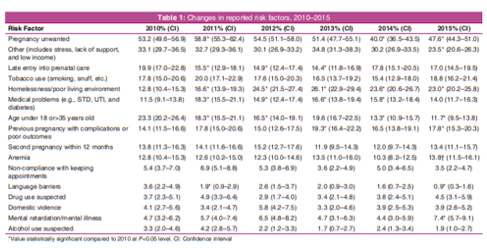
Using 2010 as a reference year, Table 1 shows how the prevalence of risk factors reported by participants has changed based on CHW reports of 4,475 participants from 2010 to 2015. We found changes from the baseline year (2010) for each subsequent year. Across program years, there was a significant reduction in the prevalence for a number of risk factors. Notably, factors related to the circumstances of the pregnancy (i.e., unwanted pregnancy, late entry into prenatal care, and age of the mother) saw a decrease over at least 1 year since 2010, with the reduction in the risk factor "age under 18 or over 35" showing a steady decrease. In contrast, the prevalence of the homelessness/poor living environment risk factor notably increased over the course of the same time frame.
As risks identified are not mutually exclusive, a mother can experience a number of them at the same time. We categorized simultaneously reported risk factors into 0, 1, 2, 3, 4, and 5 or more risk factors and assessed these risk factor categories across the three identified time windows since data collection began in 1996, 2010-2012, and 2013-2015, as displayed in Figure 1.
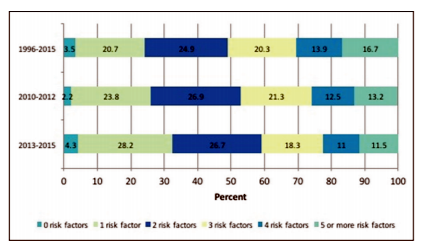
When compared to 2010-2012, we found an increase in the percentage of participants with zero or one risk factor and a decrease in the percentage of participants with four, five, or more risk factors in 2013-2015. There was a significant difference (P < 0.001), with women experiencing greater numbers of risk factors simultaneously during the 2010- 2012 time period. The majority of participants throughout program history (1996-015) (75.8%) experienced two or more risk factors simultaneously, and 96.5% of participants throughout program history experienced at least one risk factor.
Among OIMRI participants who could be directly matched to Birth Record and WRA data, we compared risk factors measured by OIMRI self-report to the same risk factors among OIMRI participants using either objective data source for the years 2010-2015 [Table 2]. We also assessed risk factors for all Black women who gave birth in Ohio using WRA or Birth Record Data during the same years.
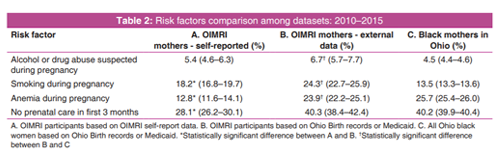
As shown, we found that Black mothers in OIMRI self-report smoking, anemia, and prenatal care in the first 3 months at statistically significantly lower rates in the OIMRI data (Group A) than Medicaid or Ohio Birth record data show as rates for the same moms (Group B). In addition, in comparison to all Black mothers in Ohio (Group C), a higher proportion of OIMRI mothers used alcohol or drugs or smoked and a lower proportion had anemia in the birth and Medicaid data (all P< 0.05).
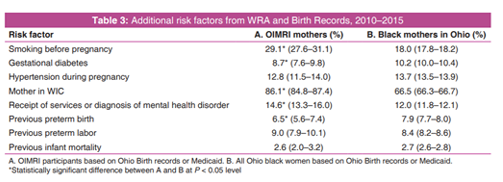
Using WRA and Birth Record Data, we examined additional risk factors that were not assessed by CHWs, comparing the percentages for OIMRI mothers (Group A) to percentages for all Black mothers who gave birth in Ohio (Group B) from 2010 to 2015 [Table 3]. Among OIMRI mothers, we Compared to all Black mothers in Ohio, larger proportions of OIMRI mothers smoked before pregnancy, were enrolled in the women, infants, and children (WIC) program, or had received services for or been diagnosed with a mental health disorder (all P < 0.05). OIMRI mothers were less likely to have gestational diabetes or a previous preterm birth than all Black mothers in Ohio (P < 0.05). However, mothers in OIMRI were similar to all Black mothers in Ohio for the risk factors of hypertension during pregnancy, previous preterm labor, and previous infant mortality.
DISCUSSION
The OIMRI program successfully recruited high-risk Black women who were more likely than Black women across the state to smoke, use alcohol or drugs, be enrolled in WIC, or have mental health disorders. Participants in OIMRI had high rates of homelessness and poor housing, unwanted pregnancy, and other environmental risk factors. The majority (75.8%) of participants for the history of the program experienced 2 or more risk factors simultaneously. Finally, in examining risk factors for infant mortality among Black mothers in Ohio, we found some variability when using different data sources. For instance, tobacco use, anemia, and late entry into prenatal care were statistically significantly more common among participants when analyzing birth record or Medicaid data than when using self-reported OIMRI data.
Several factors may contribute to the differences in risk factor prevalence rates between data sources. First, OIMRI participants may have been unwilling at program intake to disclose to a CHW some risk factors they perceived to be undesirable (e.g., smoking and drug use), but they may have been less reluctant to disclose to a health-care practitioner they met multiple times that they smoke a few cigarettes a day. Women are more engaged in prenatal care if they have a trusting relationship with their provider,[24] and this could have an effect on whether mothers report risk factors. This social desirability bias has been documented in previous research; pregnant women were found to be less likely to disclose smoking status than non-pregnant women, and among pregnant women, young women (20-24 years old) were less likely to disclose smoking status[25]. In addition, OIMRI records risk factors as binary; a participant may not perceive themselves as a "smoker" if they have only a few cigarettes a day. Similarly, underreporting may be a particularly salient problem for self-reported data when risk factors are unknown at a particular point in time. For example, a mother may not have known that she had anemia at the time of the CHW's intake assessment making self-report impossible, but other data sources will include anemia as a risk factor.
Among risk factors for infant mortality, unintended pregnancies are reportedly frequent among all women across Ohio, with 55% of pregnancies reported as unintended and 31% of those unintended pregnancies reportedly unwanted (total unwanted pregnancy rate of 17%)[26]. Notably, this rate is much lower than the unwanted pregnancy rate of 40-59% self-reported among OIMRI participants from 2010 to 2015. Since women with unplanned and/or unwanted pregnancies are more likely to have poor health behaviors during pregnancy including smoking, poor nutrition, and late or inadequate prenatal care,[27] the ability for CHWs to identify this risk factor and intervene, when possible, may be extremely important.
During their home visit intake assessment, the mothers in OIMRI were more likely to be high-risk. Could be reworded to "CHWs were able to identify women who used drugs or alcohol, smoked before and during pregnancy, or suffered from mental health problems at greater rates than average in Ohio. As each of these risk factors contributes to the constellation of challenges faced by mothers with low means, including poor nutrition, smoking, substance abuse, poor prenatal care, infections, psychological factors, and poor housing/neighborhoods,[28] identification is an important first step to mitigate these risk factors.
Further, while the rate of homelessness in Ohio in general is < 1% of the population,[29] the homelessness or poor living environment rate for OIMRI participants ranged from 12.8% to 26.1% during 2010-2015 in the OIMRI data. It is impossible to split the data into true homelessness versus poor housing; however, this still indicates high-risk environments. Both homelessness and living in neighborhoods with a low socioeconomic status are associated with excess morbidity and mortality[30,31] These rates suggest that OIMRI participants may experience additional poverty-related risk factors common among those with housing insecurity (e.g., unemployment/underemployment, lack of social support, and poor nutrition) not systematically captured by the current OIMRI assessment process, birth records, or Medicaid records that contribute to infant mortality. Additional prenatal data collection would likely help further to improve intervention activities aimed at reducing infant mortality by permitting identification of such risks.
There were strengths and limitations to these analyses. Use of multiple data sources allowed for risk factors to be compared between medical providers and community services. However, underreporting of risk factors is a limitation of the OIMRI self-report data. As risk assessment occurs at the first home visit, before trust is built between the CHW and the participant, it is possible that women purposely underreported risk factors about sensitive topics. Further, participants may have other risk factors not listed in the reported categories. Additionally, participants may have unintentionally underreported risk factors they did not personally consider risk factors (e.g., low income). There is likely underreporting in the birth records and Medicaid data as well. In addition, while using many years of data allowed for the analysis of changes in the population, due to program dropout, change in risk factors for participants over time could not be assessed. Future analyses could include additional risk factors available from external datasets, as well as analysis of frequently co-occurring risk factors.
CONCLUSION
Women in the OIMRI program reported multiple risk factors that contribute to infant mortality. The most common risk factors were unwanted pregnancy, homelessness or poor living conditions, and "other", which most frequently consisted of low income, low support, or stress. At the same time, OIMRI participants were also more likely than all Black women in Ohio to be enrolled in WIC, use drugs or alcohol, smoke, and have mental health issues from 2010 to 2015. OIMRI participants self-reported smoking, late prenatal care, and anemia at lower rates to CHWs than to medical professionals, highlighting a divide in risk reporting. As programs such as OIMRI that rely on CHWs to provide interventions depend on accurate assessments of risk factors to optimally allocate limited programmatic resources, developing ways to ensure complete reporting of such risk factors are critical.
FUNDING INFORMATION
The OIMRI Evaluation is funded by the ODH and the Ohio Department of Medicaid (ODM) and administered by the Ohio Colleges of Medicine Government Resource Center. The views expressed in this paper are solely those of the authors and do not represent the views of the state of Ohio or federal Medicaid programs. This study includes data provided by ODH and ODM which should not be considered an endorsement of this study or its conclusions.
ACKNOWLEDGMENTS
The Ohio Department of Health and ODM provided the data necessary to complete this study.
References
- Sibai BM. Diagnosis and management of gestational hypertension and preeclampsia. Obstet Gynecol 2003;102:181-92.
- Taruscio D, Mantovani A, Carbone P, Barisic I, Bianchi F, Garne E, et al. Primary prevention of congenital anomalies: Recommendable, feasible and achievable. Public Health Genomics 2015;18:184-91.
- Goldenberg RL, Culhane JF, Iams JD, Romero R. Epidemiology and causes of preterm birth. Lancet 2008;371:75-84.
- Aune D, Saugstad OD, Henriksen T, Tonstad S. Maternal body mass index and the risk of fetal death, stillbirth, and infant death: A systematic review and meta-analysis. JAMA 2014;311:1536-46.
- Kozuki N, Lee AC, Silveira MF, Sania A, Vogel JP, Adair L, et al. The associations of parity and maternal age with small-for-gestational-age, preterm, and neonatal and infant mortality: A meta-analysis. BMC Public Health 2013;13 Suppl 3:S2.
- Hussaini KS, Ritenour D, Coonrod DV. Interpregnancy intervals and the risk for infant mortality: A case control study of arizona infants 2003-2007. Matern Child Health J 2013;17:646-53.
- Matthews TJ, MacDorman MF, Thoma ME. Infant mortality statistics from the 2013 period linked birth/Infant death data set. Natl Vital Stat Rep 2015;64:1-30.
- Mei-Dan E, Walfisch A, Weisz B, Hallak M, Brown R, Shrim A, et al. The unborn smoker: Association between smoking during pregnancy and adverse perinatal outcomes. J Perinat Med 2015;43:553-8.
- Partridge S, Balayla J, Holcroft CA, Abenhaim HA. Inadequate prenatal care utilization and risks of infant mortality and poor birth outcome: A retrospective analysis of 28,729,765 U.S. Deliveries over 8 years. Am J Perinatol 2012;29:787-93.
- Bada HS, Das A, Bauer CR, Shankaran S, Lester BM, Gard CC, et al. Low birth weight and preterm births: Etiologic fraction attributable to prenatal drug exposure. J Perinatol 2005;25:631-7.
- Mohllajee AP, Curtis KM, Morrow B, Marchbanks PA. Pregnancy intention and its relationship to birth and maternal outcomes. Obstet Gynecol 2007;109:678-86.
- Lobel M, Cannella DL, Graham JE, DeVincent C, Schneider J, Meyer BA, et al. Pregnancy-specific stress, prenatal health behaviors, and birth outcomes. Health Psychol 2008;27:604-15.
- Nagahawatte NT, Goldenberg RL. Poverty, maternal health, and adverse pregnancy outcomes. Ann N Y Acad Sci 2008;1136:80-5.
- Hogan VK, Rowley D, Bennett T, Taylor KD. Life course, social determinants, and health inequities: Toward a national plan for achieving health equity for african american infants - a concept paper. Matern Child Health J 2012;16:1143-50.
- Hauck FR, Tanabe KO, Moon RY. Racial and ethnic disparities in infant mortality. Semin Perinatol 2011;35:209-20.
- Bryant AS, Worjoloh A, Caughey AB, Washington AE. Racial/ ethnic disparities in obstetric outcomes and care: Prevalence and determinants. Am J Obstet Gynecol 2010;202:335-43.
- MacDorman MF. Race and ethnic disparities in fetal mortality, preterm birth, and infant mortality in the united states: An overview. Semin Perinatol 2011;35:200-8.
- Alio AP, Richman AR, Clayton HB, Jeffers DF, Wathington DJ, Salihu HM, et al. An ecological approach to understanding black-white disparities in perinatal mortality. Matern Child Health J 2010;14:557-66.
- Brown Speights JS, Goldfarb SS, Wells BA, Beitsch L, Levine RS, Rust G, et al. State-level progress in reducing the black-white infant mortality gap, united states, 1999-2013. Am J Public Health 2017;107:775-82.
- Bureau of Maternal and Child Health. Ohio Infant Mortality Reduction Initiative Program Report 2009-2012. Columbus, OH: Ohio Department of Health; 2015.
- DeLorenze GN, Kharrazi M, Kaufman FL, Eskenazi B, Bernert JT. Exposure to environmental tobacco smoke in pregnant women: The association between self-report and serum cotinine. Environ Res 2002;90:21-32.
- Webb DA, Boyd NR, Messina D, Windsor RA. The discrepancy between self-reported smoking status and urine continine levels among women enrolled in prenatal care at four publicly funded clinical sites. J Public Health Manag Pract 2003;9:322-5.
- Connor Gorber S, Schofield-Hurwitz S, Hardt J, Levasseur G, Tremblay M. The accuracy of self-reported smoking: A systematic review of the relationship between self-reported and cotinine-assessed smoking status. Nicotine Tob Res 2009;11:12-24.
- Sword W, Heaman MI, Brooks S, Tough S, Janssen PA, Young D, et al. Women's and care providers' perspectives of quality prenatal care: A qualitative descriptive study. BMC Pregnancy Childbirth 2012;12:29.
- Dietz PM, Homa D, England LJ, Burley K, Tong VT, Dube SR, et al. Estimates of nondisclosure of cigarette smoking among pregnant and nonpregnant women of reproductive age in the united states. Am J Epidemiol 2011;173:355-9.
- Kost K. Unintended Pregnancy Rates at the State Level: Estimates for 2010 and Trends Since 2002. New York, NY: Guttmacher Institute; 2015.
- Cheng D, Schwarz EB, Douglas E, Horon I. Unintended pregnancy and associated maternal preconception, prenatal and postpartum behaviors. Contraception 2009;79:194-8.
- Institute of Medicine (US) Committee on Understanding Premature Birth and Assuring Healthy Outcomes. Sociodemographic and Community Factors Contributing to Preterm Birth. In: Behrman RE, Butler AS, editors. Preterm Birth: Causes, Consequences, and Prevention. Washington D.C: National Academies Press; 2007.
- United States Department of Housing and Urban Development Office of Community Planning and Development. The 2015 Annual Homeless Assessment Report (AHAR) to Congress Part 1: Point-in-Time Estimates of Homelessness; 2015.
- Ayoade A, Haaramo P, Kautiainen H, Gissler M, Wahlbeck K, Eriksson JG, et al. Mortality and causes of death among homeless in finland: A 10-year follow-up study. J Epidemiol Community Health 2017; 71:841-848.
- Moser A, Panczak R, Zwahlen M, Clough-Gorr KM, Spoerri A, Stuck AE, et al. What does your neighbourhood say about you? A study of life expectancy in 1.3 million swiss neighbourhoods. J Epidemiol Community Health 2014;68:1125-32.