Water Intake and Burden of Urinary Tract Infection among School Girls
K. K. Lamiya1, Jasna P. Kunjabdulla1, Jinsa Salim1, P. Jyothika1, K. Lakshmi1, L. Aiswarya1, A. Betsy1, P. Bincy1, Jesha Mohammedali Mundodan1
Citation : Lamiya KK, Kunjabdulla JP, Salim J, Jyothika P, Lakshmi K, Aiswarya L, Betsy A, Bincy P, Mundodan JM. Water Intake and Burden of Urinary Tract Infection among School Girls. J Community Prev Med 2018;1(1):1-5.
Urinary tract infection (UTI) is a common infection. Studies show that school girls are more prone to develop UTI.
A cross-sectional study was conducted among 110 school going girl students aged 10-13 years. Considering the prevalence of UTI among school going girls to be 16.6% and 7% error, the sample size was calculated to be 113. Participants were selected from classes 5th, 6th, 7th, and 8th. A brief description was given to the girls about the urinary tract in the human body and why females are susceptible to UTI. The students were explained about the method of midstream urine collection. A semi-structured pre-tested questionnaire was used to assess the adequacy of water intake, pattern of water intake, reasons for low water intake (if inadequate), awareness about diseases caused by low water intake, and history of UTI (if any) in the past 6 months. Urine samples were collected in sterile bottles and subjected to urine routine examination at our hospital central laboratory within 20 minutes of collection.
We found 30.9% of the study population had UTI. Only 12.7% had adequate daily water consumption and 71.8 % were not having adequate water intake during school hours. The main reason for inadequate intake was reported as lack of awareness of adequate amount. A significant association was noted between UTI and poor menstrual hygiene, use of school toilets as well as the previous history of UTI.
Burden of urinary tract infection, school going girls, water intake
INTRODUCTION
Urinary tract infection (UTI) is a common infection affecting millions of people each year, accounting for 8.3 million cases per year (WHO1997) [1]. UTI is the second leading cause of morbidity [2]. Women are more prone to UTI. One in five women develops UTI during her lifetime [2]. The anatomy of female urogenital tract with the shorter urethra (1.5 inches compared to 8 inches in males) and proximity of urethral opening to vagina and anus increases their risk for UTI. Other risk factors include poor and incorrect urinary and toilet habits, poor hygiene, and sexual activities, especially with multiple sexual partners.
Studies show that school girls are more prone to develop a urinary infection. The risk for UTI is higher during adolescence, as the hormonal changes favor vaginal colonization by nephritogenic strains of bacteria, which can migrate to the periurethral area [3]. Poor toilet hygiene, improper toilet habits, poor sanitary condition of school toilets, and inadequate drinking of water are some of the common reasons cited in a study done in Anambra state of Nigeria [4].
A survey conducted among 4-16-year-old healthy primary school children (50 girls and 50 boys) in Awka Local Government area of Anambra state in Nigeria, a rural Nigerian community showed that 12% of boys and 48% of girls were positive for infection [4]. James revealed that 1.7 per 1000 adolescent girls were at risk of UTI compared to1.3 per 1000 boys [5]. Another study done in Mangalore too showed female preponderance [6].
Adequate hydration is essential for maintaining the equilibrium of the body. Inadequate hydration can lead to serious complications ranging from UTI to chronic kidney diseases. A low fluid intake (<1L/day) can lead to reduced physical and cognitive performances. Adequate hydration is obtained by balancing the water intake (80%) and endogenous water production (20%) with water losses. The amount of metabolic water is, however, limited, varying between 250 and 350 ml/day in sedentary people and 600 ml/day inactive people. Source of water intake is fluids (drinking water, beverages, etc.), moisture content of food and water produced by an oxidative process in the body.
Requirement of water intake varies between individuals and is influenced by many factors such as age, sex, climate, physical activity, and diet. Due to this variability, a minimum level of water intake cannot be used to set water requirements as the risk for water deficiency would be high. For children aged between 9 and 13 years, the requirement is 1900 ml/ day (approximately 8 glasses) for girls and 2100 ml/day for boys. As children in this age group spend the majority of their daytime in school, they should consume a significant proportion during school hours.
Hence, the present study evaluates the pattern of water intake and burden of UTI among school going teenage girl children.
The objectives are as follows:
1. To assess the burden of UTI among 10-13-year-old school going girls
2. To study the pattern of water intake among them
3. To find out the reasons behind reduced consumption of water (if any) among them
4. To look for an association between development of UTI and reduced water intake and perineal hygiene.
MATERIALS AND METHODS
A cross-sectional study was conducted between November 8 and December 8 2016 among girl students aged 10-13 years of Panakkad Thangal Memorial Upper Primary School, Puthanangadi. Considering the prevalence of UTI among school going girls to be 16.6% (NHFS) and 7% error, the sample size was calculated to be 113. Participants were selected from classes 5th to 8th. Assuming that there will be average 30-35 students in a division, one division each from 5th, 6th, 7th, to 8th were included in the study to meet the sample size. The division was allotted by the principal of the school. Students who were having menstrual periods at the time of the study, not willing to participate, mentally challenged and not present on the day of data collection were excluded. Informed consent was taken from the principal and the parents through PTA meetings. On the day of data collection, informed verbal assent was taken from participant students of the selected classes.
A brief description was given to the girls about urinary tract in the human body, female susceptibility for UTI and the purpose of this study. A semi-structured questionnaire was used to assess adequacy and pattern of water intake, reasons for low water intake (if inadequate), effect of inadequate water intake, and history of UTI in past 6 months. The students were explained about the method of midstream urine collection, and sterile urine sample collection bottles were given to them. They were asked to fill three-fourth of the bottle with urine. After collecting the urine, sample bottles were kept in carrier boxes with ice packs and were brought to MES hospital central laboratory within 20 min of collection. The samples were subjected to urine routine examination including the presence of bacteria and pus cells.
Students consuming <8 glasses of water a day or <5 glasses (roughly 1 L) a day during school hours were considered to have low water intake. Changing of more than 3 pads a day was considered as a sign of good menstrual hygiene.
Data were analyzed using Epi info. Descriptive analysis was done. Proportions of students having bacteria in urine and low water intake were expressed in percentages. Association between UTI and low water intake, use of school toilets, personal hygiene, perineal hygiene, menstrual hygiene, and previous history of UTI were looked for using Chi-square test.
RESULTS
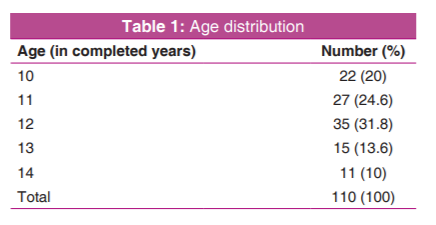
A total of 110 girl students in the age group 10-13 years were included. The mean age of the study participants was 12.09 years. Table 1 depicts the age distribution of the study population.
On urine analysis of the samples collected, pus cells were seen in 69 samples, and 34 urine samples were positive for bacteria. Hence, 30.9% of our study population had UTI at the time of the study.
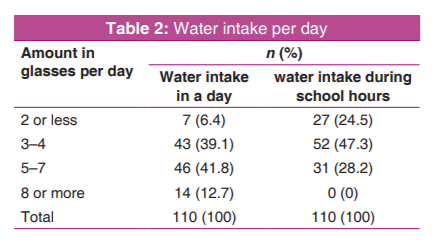
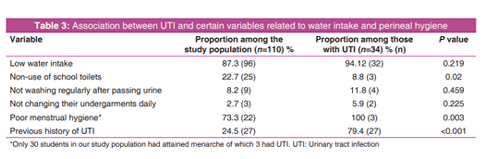
Only 14 of the 110 (12.7%) in this study had adequate water consumption, i.e. 8-10 glasses per day. Assuming intake of <5 glasses of water (roughly 1 L) during school hours as inadequate, 71.8% in our study was not having adequate water intake during school hours. Table 2 shows water intake per day of our participants. Of the 34 girls with UTI, 32 were found to have low water intake, but no significant association was seen between low water intake and UTI (P 0.219) [Table 3].
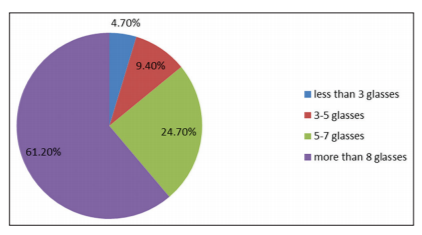
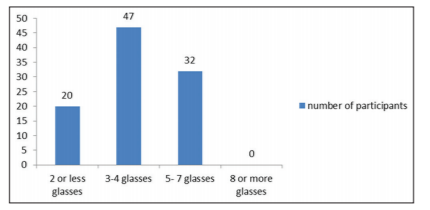
When asked about the reason for inadequate consumption, 11 said it was because of the difficulty in bringing water to school, while most (89) responded that they were not aware that their consumption was inadequate. Contradictory to the finding that of 96 inadequate water consumers 89 were unaware that their consumption was insufficient; 61.2% responded that 8 or more glasses of water are required daily when they were asked about the daily requirement [Figure 1]. Nearly, a quarter responded that the daily water requirement to be 5-7 glasses. When asked about the consequences of poor water intake, 88.2% knew poor water intake can lead to UTI s, and 10.6% knew it can cause kidney disorders. Only 5.9% responded that they do not know what disease will be caused if water intake is poor.
Of the 110 participants, 90% (99) brought water to school from their homes. Figure 2 depicts the distribution of the 99 participants according to the amount of water these students brought to school. 21 participants consumed water provided in school also as the quantity they brought from home was insufficient. Four of the 34 with UTI did not bring water to school, but no significant relation was seen between bringing water to school and UTI (P = 0.735).
One girl reasoned that she did not bring water to keep her consumption from school low so as to avoid using dirty toilets in the school. The other 10 girls did not bring water from home because of the difficulty in carrying heavy bags; moreover, water was anyway provided from the schools. Five of these 10 girls reported sharing water with friends and five reported consuming water provided in school.
Of the 110 participants, 25 do not use the school toilets. Out of the 34 girls with UTI, three did not use the toilets in their school. A significant relation was seen between UTI and nonuse of school toilets (P = 0.02).
Nine (8.2%) girls reported not washing perineal region regularly after passing urine and four among those with UTI reported similarly. No significant relation was established between regular washing of perineal region after passing urine and UTI (P = 0.459). Three (2.7%) girls reported that they do not change their undergarments daily and among those with UTI, two reported the same. No significant relation was seen between changing undergarments daily and UTI (P 0.225).
A total of 30 students had attained menarche in our study population. Only eight (26.7%) girls followed hygienic practice. Only three among the 34 girls with UTI had attained menarche, and these three girls practiced poor hygienic practices. A significant relation was noted between poor menstrual hygienic practice and UTI (P 0.003).
Nearly, a quarter (24.5%) gave a history of UTI. These 27 girls who gave a previous history were found to have UTI now on urine analysis and all of them reported having 5 or less glasses of water a day. The previous history of UTI was strongly related to current UTI (P < 0.001).
DISCUSSION
In our study, it was found that 30.9% of urine samples were positive for bacteria. Similar to the study by Ram et al. among adolescent girls (37%) [7]. Our result was nearly double the prevalence reported by National Family Health Survey (16.6%) [8] and thrice the finding of the survey conducted in Mangalore (10.57%) [6]. A cross-sectional study carried out among adolescent and pre-adolescent girls (10-19 years) in the rural district of Karimnagar of Andhra Pradesh showed prevalence to be 12.7% (23 girls) [9]. Singh et al. reported a lower prevalence of 4.2% [10]. In a Tanzanian study, the prevalence of UTI was found to be 19.5% among 6-17-yearold girls [11] Another study carried out in Nigeria among 5-18-year-old, 28 of the 124 females examined (22.5%) had a positive urine culture [12]. Although a field-based study, the urine analysis in our study was done in the laboratory of a tertiary care hospital and this may have been the reason for higher yield and hence a higher prevalence than most Indian studies.
In our study, 87.3% were not having adequate water intake, similar to 86.5% in the study done in the USA by Jasper et al [13]. Senterre et al. found that 90.5% of school girls are taking inadequate water [14]. As per water and beverage consumption among the 4-13-year-old in the US: NHANES data, 87% of the 9-13-year-old girls did not meet the daily requirement for total water intake [15]. Florida Youth Physical Activity and Nutrition Survey among 4292 students in grades six through eight in 86 Florida public middle schools in 2007 found that about 64% of students had low water intake (<3 glasses/day) [16]. According to a French study, intake among 1005 children aged 6-11 years were adequate in 36% [17]. In a Belgium study among school girls of 9-13-year-old (3rd-6th graders) only 7% had adequate fluid intake (including water) and 36% of the total fluid intake was from water; and 27.7% declared an intake of <3-4 glasses/day while 56% <2/ day and 7.7% reported no water intake [14].
In the present study, 8.2% of girls reported not washing their perineal region after passing urine, while among those 34 with UTI (4), 11.8% reported not washing. In a study done in Ahmedabad by Bokolia, of 307 school-going adolescent girls aged 12-16 years, 186 (60.58%) are not washing their vaginal area after urination and girls practicing improper perineal washing technique suffered more (8.3%) from urinary infection than those who did not (4.4%; P < 0.05) [18]. In a Nigerian study by Mustafa et al., a much higher proportion (63.3%) reported washing after voiding urine [19] The better awareness regarding personal hygiene among the girls in our study may be the reason for our lesser finding. However, no significant relation was established between washing after passing urine and UTI (P 0.459) in our study in contrast to the study done by Ahmed and Avasarula where he found a significant association between UTI and improper perineal washing technique (P < 0.001) [9].
In this study, only 3 among the 34 girls with UTI had attained menarche, and these 3 girls practiced poor hygienic practices (changing <3 pads a day). In the study done by Bokolia, 87.94% girls change sanitary pads more than one time in a day during menstruation [18]. In the study by Ahmed and Avasarula, prevalence of UTI was found to be more (9.9%) in girls who had attained menarche than those who had not (2.8%) and a significant association between prevalence of UTI and use of unsanitary pads during menses (confidence interval = 95%, P < 0.001) was noted [9]. A significant relation was noted between poor menstrual hygienic practice and UTI (P 0.003) in our study too.
In the present study, significant association was noted between UTI and poor menstrual hygiene, with non-use of school toilets as well as the previous history of UTI but no association was noted with inadequate water intake. Poor toilet hygiene, improper toilet habits, poor sanitary condition of school toilets and inadequate drinking of water are some of the common reasons cited in a study done in Anambra state of Nigeria [4].
CONCLUSIONS
UTI was noted in <1 third. Adequate water intake was seen only in 12.7%. Most students brought water to school still intake was inadequate. The main reason for inadequate intake was reported as lack of awareness of adequate amount. A significant association was noted between UTI and poor menstrual hygiene, with non-use of school toilets as well as the previous history of UTI. Those with positive results were recommended to consult a doctor and have a urine culture test done.
Ignorance of daily fluid requirement and perineal hygiene may lead to UTI and if left unidentified without medical intervention it is likely to go on to serious urinary and genital tract complications. This calls for an urgent need for education of teenage girls periodically addressing these gaps. Involvement teachers, parents, and School Authority in the awareness program are required. Make pure potable water available at schools. The school authority must take necessary action to assure accessibility to clean toilets in their schools.
References
- WHO 1997 or Acharya UN. Urinary tract infection current status. J Post Graduate Med 2008;38. Available from: http://www.jpnonlin.comwww.rguhs.ac.in/cdc/onlinecdc/ uploads/05_N189_6940.doc. [Last accessed on 2017 Jun 20].
- Barry BM. Women Healthcare. Available from: http://www. pdr.net. [Last accessed on 2017 Jun 18].
- Sain R, Thakur N. Health problems of adolescents. Health Action 2007; 26
- Azubike CN, Nwamadu OJ, Oji RU, Uzoije N. Prevalence of urinary tract infection among school children in a Nigerian rural community. West Afr J Med 1994;13:48-52.
- James S. Survey on incidence of urinary tract infection. J Urol 2000;49:47-58.
- Kumar CS, Jairam A, Chetan S, Sudesh P, Kapur I, Srikaramallya, et al. Asymptomatic bacteriuria in school going children. Indian J Med Microbiol 2002;20:29-32.
- Ram S, Gupta R, Gaheer M. Emerging antibiotic resistance among the uropathogens. Indian J Med Sci 2000;54:388-94.
- National Family Health Survey, Government of India; 1998. Available from: http://www.rchiips.org/nfhs/nfhs3.shtml. [Last accessed on 2017 Jun 18].
- Ahmed SM, Avasarula AK. Urinary tract infection among adolescent girls in rural Karimnagar District. Indian J Prev Soc Med 2008;39:67-70.
- Singh MM, Devi R, Garg S, Mehra M. Effectiveness of syndromic approach in management of reproductive tract infections in women. Indian J Med Sci 2001;55:209-14.
- Sekharan CB, Kumari KR, Kuwingwa EE, Kumar DD. Evaluation of the prevalence of urinary tract infection in females aged 6-50 years at Kinondoni District, Tanzania. Sci Int 2017;5:42-6.
- Aiyegoro OA, Igbinosa OO, Ogunmwonyi IN, Odjadjare EE, Igbinosa OE, Okoh AI. Incidence of urinary tract infection among children and adolescents in the Il Lfe, Nigeria. Afr J Microbiol 2007;1:13-9.
- Jasper C, Le TT, Bartram J. Water and sanitation in schools: A systematic review of the health and educational outcomes. Int J Environ Res Public Health 2012;9:2772-87.
- Senterre C, Dramaix M, Thiebaut I. Fluid intake survey among schoolchildren in Belgium. BMC Public Health 2014;14:651.
- Drewnowski A, Rehm CD, Constant F. Water and beverage consumption among children age 4-13y in the United States: Analyses of 2005-2010 NHANES data. Nutr J 2013;12:85.
- Park S, Sherry B, O'Toole T, Huang Y. Factors associated with low drinking water intake among adolescents: The florida youth physical activity and nutrition survey, 2007. J Am Diet Assoc 2011;111:1211-7.
- Centre de Rechere pour l'Etude l'Observations des Conditions de Vie. Available from: http://www.credoc.fr. [Last accessed on 2017 Jun 07].
- Bokolia R. Assessment of Knowledge of Urinary Tract Infection (UTI) Amongst School-Going Adolescent Girls. Ahmedabad, India: K. B. Institute of Pharmaceutical Education & Research; 2016.
- Mustafa AI, Haruna I, Ibrahim A, Abubakar S, Mustapha A. Prevalence of urinary tract infection among primary school children in Maiduguri, Borno State, Nigeria. Int J Environ 2013;2:9-15.