The Importance of Individual Attitudes and Behaviors and their Impact on Longevity
Alan H. Rosenstein1
Citation : Rosenstein AH. The Importance of Individual Attitudes and Behaviors and their Impact on Longevity. J Community Prev Med 2018;1(1):1-4.
In 2018, the average life expectancy after birth for individuals living in the United States is approaching 79 years. The oldest recorded age at death is 117 years. The most common causes of death are the consequences of chronic disease. Taking accountability for one's actions in regard to lifestyle choices can have a significant impact on increasing the quality and quality of life.
Practicing Internal Medicine, San Francisco, California
INTRODUCTION
According to the Centers for Disease Control, the average life expectancy at birth in the U.S is 78.7 years [1]. The leading causes of death are heart disease, cancer, injuries, respiratory disease, stroke, Alzheimer's, diabetes, influenza and pneumonia, kidney disease, and suicide [1]. 74% of deaths are attributed to these top 10 leading causes of death. Not bad, but the U.S. life expectancy lags behind 30 other countries whose life expectancy is above 80 years of age. Japan ranks the highest with an average life expectancy of 83.7 years [2]. So what can we do to increase our chances for a long healthy life.
FACTORS AFFECTING LIFE EXPECTANCY
Over the years, we have made significant advancements in increasing longevity. In the early 1900s, life expectancy after birth was <50 years of age. Since then, significant advancements in sanitation, hygiene, and the prevention and treatment of infectious diseases increased average life expectancy to 65 years by the mid-1960s. In the mid-1970s, average life expectancy increased to 75 years. Since that time, we have made only minor improvements in life expectancy as the major causes of death have shifted more toward the prevalence and consequences of chronic disease. So what do we have to do to make further improvements? It is all about lifestyle management.
Some of the underlying factors affecting life expectancy are difficult to modify. 10-15% of mortality can be attributed to genetic or familial traits. Certain types of cancer, heart disease, diabetes, neurologic disease, and a number of other congenital diseases increase the likelihood of disease progression and shortened life expectancy for individuals with these genetic markers. Fortunately, new breakthroughs in genetic testing, stem cell treatment, and personalized medicine can help address some of these issues.
Other factors affecting overall life expectancy include socioeconomics, geography, pollution, education, race, religious beliefs, culture, and ethnicity. These represent deepseated society issues which may best addressed by community support and government sponsored relief programs.
Another 10-15% of individuals will develop a serious medical condition which may shorten life expectancy due to accidents or chance. Examples include the occurrence of premature heart disease or cancer without known underlying risk factors. The only recommendation here is caution and to pay more attention to early warning symptoms, and if warranted, seek medical advice for diagnosis and treatment.
For the more than 50% of the population who are not included in these groups, life expectancy is influenced to a large extent by risk management, lifestyle choices, and control of chronic disease. Let me explain what you can do.
IMPROVING LIFE EXPECTANCY: RISK MANAGEMENT
Table 1 provides an overview of steps that can be taken to improve both the quality and quantity of life.
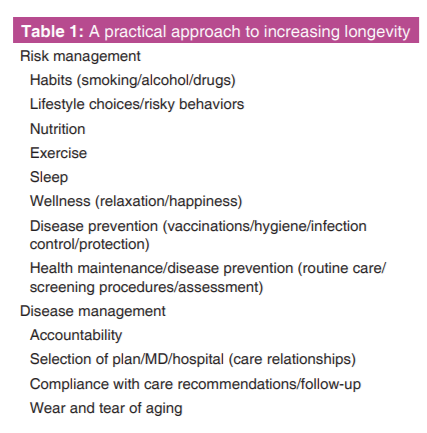
The first series of steps falls under the category of risk management. Avoiding (or discontinuing) smoking is the number one recommendation for avoiding the known disease states (cardiovascular, respiratory, cancer, and other) attributed to smoking and second-hand smoke. There are a number of different regimens available to help smokers quit which range from willpower to hypnosis to medication regimens. Substituting e-cigarettes for smoking is not without its own associated risks. Try whatever works for you, and in resistant cases, seek medical advice. If you have not started, don't.
Excess alcohol is also a known risk factor for liver disease, cancer, and other metabolic problems. You note that I say "excess" alcohol. There are a lot of studies, suggesting that small amounts of alcohol (red wine in particular) may actually provide a beneficial health effect. Medically, we believe that one drink a day is an acceptable amount unless there are underlying medical problems that may be associated with alcohol intake.
Drug addiction is a growing area of concern. Issues related to heroin, methamphetamines, and now opioid addiction are a growing problem which is now creeping into the top ten causes of premature death. There are numerous efforts being introduced to help address the growing drug/opioid addiction problem. If you have not started, do not. If you suspect that someone is addicted make an effort to encourage them to seek medical advice.
Another topic I have included under risk management is lifestyle choices. A lot of this has to do with knowingly engaging in risky behaviors and making inappropriate choices and decisions. Think twice before you choose.
There is a strong correlation between diet and disease. Poor nutrition is associated with certain types of cancer (colon), metabolic disease (diabetes), lipid abnormalities (cholesterol and triglycerides), cardiovascular disease (arteriosclerosis), hypertension (salt), and a variety of other medical conditions. An appropriate diet intake needs to monitor both the quality and quantity of food intake. From a quality perspective avoidance of saturated fats (fast foods, greasy meats, and excess dairy products) and excess carbohydrates (sugars, starches),is a positive step in maintaining a healthy diet. Many recent medical studies have promoted the value of the "Mediterranean diet" which is high in fruits, vegetables, nuts, grains, fish, and chicken (skinless) as the primary meat sources. As far as quantity, it all has to do with calories. 3500 calories is equal to one pound. How many calories do we need a day? That depends on age (metabolic rate starts to diminish after age 40), gender (males have a higher metabolic rate than females), current weight (overweight people require more calories to keep that weight), and activity/exercise levels. If you are in your 30s, your daily caloric requirement is about 2800-3200 calories a day. If you are in the past 50, it is closer to 2000 calories a day. Be conscious of extremely high calorie foods. A Big Mac, fries, and Coke contains over 1200 calories. A piece of blueberry pie with two scoops of ice cream contains over 800 calories. In addition to being conscious about the intake of high calories foods, also pay attention the quantity of consumption of 100 - 150 calories per serving food products such as bread, cheese, sodas, alcoholic drinks, and that second serving of pasta. Studies suggest that more than 50% of the population in the U.S. is overweight. Eating behaviors can be controlled. Do not eat when you are not hungry. Do not multitask and avoid eating distractions (TV and electronics). Focus on what you are consuming. Sometimes you just need to push yourself away from the table, wait 10 min, and then see if you are still hungry. In regard to vitamin supplements, other than medications taken for a specific need (calcium, iron, and B12), there is no real controlled study evidence that vitamins really make an impact. However, the fact that people think that it helps enhance a positive attitude which has a definite value in promoting a positive lifestyle benefit. On a more positive note, there have been several recent studies promoting the value of dark chocolate, nuts, eggs, mushrooms, and coffee.
As for exercise, a 30-min moderate exercise regimen will burn off 300-400 calories in your 20s and 30s, 250 calories in your 40s, and 200 calories in your 60s. Exercising 3-4 times a week for 30 min is a perfect goal. It is not so much what exercise you do as what your heart rate is doing. Younger people can strive to reach their target heart rate. Older exercisers should exercise to the point where they get moderately short of breath. Stretching, flexibility, and weights should also be included in your exercise regimen. You don't have to go out and purchase a membership to a gym or buy an expensive piece of equipment. Walking is an excellent exercise as long as you walk fast enough, walk up and down inclines, or carry additional weights to increase your heart and breathing rate. When in doubt it is often helpful to work with an exercise trainer. Stay active and avoid a sedentary existence.
It has been well documented that happy people tend to have a longer life expectancy. This feeling of wellness is related to companionship, purpose, resilience, and an overall positive attitude to life. Deterrents to happiness include stress, depression, social isolation, and feelings of despair. Make time for joy and relaxation. For older individuals, staying active by being an active part of a community or assisted living services will help them maintain a social network to share positive experiences. For more depressed individuals, counseling and therapy are always options that should be considered.
The last topic under risk management is health promotion and disease prevention. A recent study in Health Affairs showed that only 8% of almost 2,800 surveyed US adults older than 35 were receiving all of the 15 highly recommended preventive services with the greatest potential for enhancing their health, including osteoporosis screening, blood pressure checks, vaccinations, and tobacco use counseling [3]. Have regular contact with your physician or other health-care practitioner. Do not believe everything you read on the internet. Keep abreast of recommended vaccinations and immunizations. Have regular examinations with appropriate health-care screenings including a physical, blood work, and cancer screening tests such as pelvic examinations, mammography, and colonoscopy procedures. If you are unsure about any unusual persistent physical or emotional symptoms, contact your health-care provider for advice. Early disease detection and intervention dramatically increase the chance of a successful outcome.
IMPROVING LIFE EXPECTANCY: DISEASE MANAGEMENT
Chronic diseases (cardiovascular disease, respiratory disease, diabetes, and cancer) account for the major causes of mortality. If you cannot prevent the occurrence of these diseases by self- management, the most important thing to do is to allow the medical system to help you manage these conditions as effectively as possible.
The first step is to establish accountability for one's own actions. Recognize the importance of your condition and do not try to ignore, postpone, or second guess what you need to do to keep things in check. Many of these chronic conditions can be well controlled enabling the patient to lead a long productive life.
Having said that it is equally important to find the right health-care provider. Some of these options may be limited by health-care insurance (or lack of insurance) options, emergency situations, or provider access and capacity. Finding a physician or other aligned health-care practitioner who is willing to take the time to communicate with you, listen to you, answer your questions, appreciate your values and concerns, and set expectations is the key to a successful relationship. As an Internist, most of my patient's symptoms do not fall into a specific disease category. The advantage of listening to patients and providing patient reassurance and follow-up advice is often the best way to address their issues. Be aware that some of these communication problems can be exacerbated by health-care technology with information being passed back and forth electronically which undermines the traditional doctor-patient face-to-face relationship. When in doubt, always make an effort to talk directly with your provider.
For a successful outcome, it is always important to follow the doctor's recommendations as to medications, symptoms, and follow-up visits. Reported non-compliance rates of 30-40% can certainly compromise care. If you have a question or have difficulty in following the doctor's recommendations related to problems with understanding, logistics, economics, family support, or transportation needs, always reach out to your physician for advice.
When my patients come to me for their annual examination, I ask them how their doing and for the older population their typical response is "I'm getting older". My response to them is that it beats the alternative.
Aging is a natural process. Your arteries get a little narrower (arteriosclerosis and circulatory problems), you forget things, your joints begin to compress (osteoarthritis), you lose the fluid mobility in your joints (stiffness and lack of flexibility), you lose elastic tissue (everything drops and droops), you lose hormones (menopause and erectile function), your metabolism slows (energy and sleep disturbances), and you begin to develop age-related deterioration in the functioning of the key organs (heart, brain, kidneys, and other). The buffer is to stay active, eat right, think right, relax, and maintain a positive productive daily routine with hobbies, activities, social events, family gatherings, excursions, and vacations. Do things while you can. Follow-up on that bucket list. Have a purpose and do the things that make you happy.
CONCLUSION
If your goal is to live a long healthy high-quality life, then recognize what you should (and should not) do by taking individual accountability for managing your life. More than 50% of a person's health and longevity can be attributed to the choices that we make, the risks we avoid, our lifestyle choices, and how we manage medical illness. Work with your health-care provider to promote disease prevention, wellness, early intervention, and effective care management. Maintain a positive attitude and reap the long-term benefits.
References
- NCHS Data Brief No. 293, December 2017. Available from:
https://www.cdc.gov/nchs/products/databriefs/db293.htm. [Last accessed on: 2018 June 14]. - Available from: https://www.en.wikipedia.org/wiki/List_of_ countries_by_life_expectancy. [Last accessed on: 2018 June 14].
- Borsky A, Zhan C, Miller T, Ngo-Metzger Q, Bierman AS, Meyers D, et al. Few Americans receive all high-priority, appropriate clinical preventive services. Health Aff (Millwood) 2018;37:925-8.