Depression and Diabetes - population-based Cross-sectional Study
Ishan Pathak1, Sanjay Kambar2
2. Department of Community Medicine, Jawaharlal Nehru Medical College, Specialist in Diabetes Centre, KLES Dr. Prabhakar Kore Hospital and MRC, KLE University Belagavi, Karnataka, India.
Citation: Pathak I, Kambar S. Depression and Diabetes - population-based Cross-sectional Study. J Community Prev Med 2018;1(1):1-4
Patients with both diabetes and depression have poor adherence to self-care regimens. Depression is often unrecognized and untreated in diabetes patients. The reported prevalence of depression in patients with diabetes varies widely; a meta-analysis that included 39 studies demonstrated that 31% of patients with diabetes experienced depressive symptoms.
The objectives of the study were to assess the prevalence of depression among diabetes patients and to study the sociodemographic and clinical factors leading to depression.
This population-based cross-sectional study was conducted among 600 known diabetic patients in two Urban Health Centers attached to Jawaharlal Nehru Medical College, KLE University Belagavi, India. A predesigned pre-tested questionnaire (Hamilton rating scale for depression) was used to assess depression in diabetics after taking a written informed consent.
A total of 48% were found to be under depression. Mild and moderate depression was accounted for 16% each, while severe and very severe depression was seen in 9% and 7% of the total participants, respectively.
A positive correlation of depression among diabetics was found for age, marital status, duration of diabetes, and hypertension. Almost all the patients have not consulted a psychiatrist yet and were not on any medications for depression.
Depression, diabetes, Hamilton rating scale.
INTRODUCTION
India is presently home to 62 million diabetics [1] an increase of nearly 2 million in just 1 year. India is second only to China which is home to 92.3 million diabetics [2]. Depression is one of the most common psychiatric disorders in the world [3]. Recently conducted world mental health surveys indicate that major depression is experienced by 10-15% people in their lifetime and about 5% suffer from major depression in any given year. Lifetime prevalence of all depressive disorders taken together is over 20% [4]. Depression is often unrecognized and untreated in diabetes patients. The reported prevalence of depression in patients with diabetes varies widely. In this, we particularly focused on the prevalence of depression among known cases diabetes patients and to study the sociodemographic and clinical factors leading to depression.
MATERIALS AND METHODS
This community based cross-sectional study was conducted among known diabetic patients in two Urban Health Centres located in the field practice area of JN Medical College, Belagavi. A predesigned pre-tested questionnaire (Hamilton rating scale for depression) was used to assess depression in diabetics after taking a written informed consent. The correlation of depression was found with gender, age, marital status, duration of diabetes, and a diagnosis of hypertension scoupled with diabetes.
The following criteria were included in this study:
1. Patients above the age of 20 years
2. Patients of both sexes were taken
3. Patients with established Type II diabetes
4. Patients with undiagnosed Depression.
The following criteria were excluded from the study:
1. Associated drug and alcohol dependence
2. Type I diabetes patients
3. Presence of any psychiatric or organic illness
4. Any history of psychiatric illness.
On the basis of previous studies, the sample size was taken as 600. The study subjects were taken from Urban Heath Training Centre of KLE University's Jawaharlal Nehru Medical College, based at Ashok Nagar, Belagavi.
The Hamilton rating scale for depression constitutes of 21 questions, the scoring is done for the first 17 questions and accordingly the patients are labeled as normal (score 0-7), mild depression (score 8-13), moderate depression (score 14-18), severe depression (score 19-22), and very severe depression (score =23).
The data were analyzed with SPSS version 17 and P = 0.05 was considered statistically significant. The study was approved by the Institutional Ethics Committee.
RESULTS
Table 1 is the demographic profile of the study participants where it accesses the study sample according to gender, age, educational status, marital status, duration of diabetes, and positivity to hypertension.
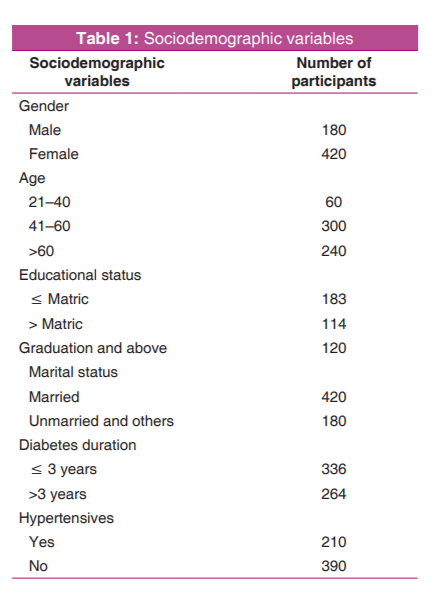
Females are more than males, maximum participants (90%) are above the age group of 21-40, as it is an urban study most of the study subjects are literate. 70% of the total participants are married and 56% have diabetes for <3 years. 35% of the total study subjects have comorbid hypertension as well.
Table 2 categorizes the study participants on the Hamilton depression rating scale. 48% of the subjects were found to be under depression. Mild and moderate depression accounted for 16% each while severe and very severe depression was seen in 9% and 7% of the total participants. Females were having more depression (55.71%) than males (30%).
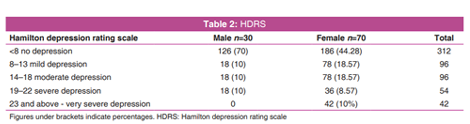
Table 3 gives the prevalence of distribution of symptoms based on HRDS, while maximum number of participants complained about depressed mood (74%), about half (52%) had anxiety as a positive symptom. More than half of the total participants had an insight about having diabetes (60%) and Suicidal thoughts were confessed the least (16%).
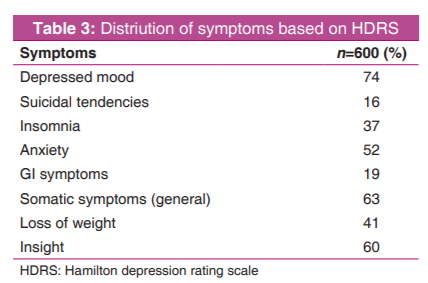
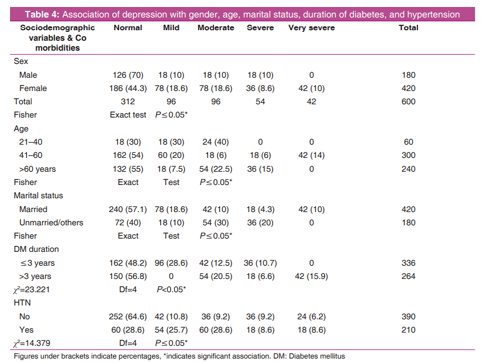
Table 4 indicates a significant association of sociodemographic factors (gender, age, and marital status) and comorbidities (duration of diabetes and positivity to hypertension) in the study participants with depression. P <0.05 was taken as significant; all the factors were found to be positively associated.
DISCUSSION
In our study, the overall prevalence of depression was found to be 48% which is slightly higher than the studies done by Raval et al [5]. (41%), Khuwaja et al [6]. (43.5%), Balhara and Sagar [7] (38.21%), and Li et al [8]. (45%), and it was significantly higher than Ali et al [9]. (27.05%), Nasser et al [10]. (33.3%), and Al-Ghamdi [11] (34%) while slightly lower than Mathew et al [12]. (49%) and Tovilla-Zarate et al [13]. (48.27%). This variation could be due to differences in sociodemographic and sociocultural factors, such as eating habits, ethnicity, and work culture.
A recent meta-analysis including around 50,000 people with Type 2 diabetes but with no depression at baseline has showed that the incidence of depression is also 24% higher in people with diabetes [14].
In many studies, comorbid depression along with diabetes has been found to have negative implications such as poor glycemic control [15], poor adherence to the line of treatment [16], and even increased risk of microvascular complications [17]. Other studies suggest that depression in diabetics has been significantly associated with decreased quality of life [18], increased health-care costs, and mortality risk [19]. Psychosocial stressors related to a chronic medical condition are being considered to explain the presence of depression in patients with Type 1 and Type 2 diabetes [19].
The prevalence of severe depression, in the present study, was found out to be 9% which is lower than Raval et al [5]. (23%) and higher than Thour et al [20]. (4%).
Depression was not found to be significantly associated with sex which is similar to the study done by Balhara and Sagar [7] whereas in the present study depression was found to be significantly associated with increasing age and unmarried/ widowed status. These results are similar to the studies done by Mosaku et al [21]. and Almawi et al [22]. This could be due to the fact that older patients are overburdened mentally, lead a physically restrictive life and thus are more vulnerable for depression. Similarly, duration of diabetes and harboring hypertension along with it was also significantly associated with depression, the same associations have also been reflected in the studies done by Almawi et al [22]. and Iype et al [23].
CONCLUSION
Almost half of the total study subjects were found to be depressive, however severe and very severe depression was found in 16% of the participants. Almost all the participants were undiagnosed for depression, and no one had ever considered taking a psychiatric consultation. It is well inferred that existing comorbid depression in people with diabetes not only leads to increased disease severity, complications, work disability, and diminished quality of life but is also associated with increased dependency on medical services and practically higher health-care costs. Thus, screening of individuals with already established diabetes for depression and prompt psychiatric consultation can help patients a great deal in the management of their health-related issues and lead a socially productive life.
References
- Kapoor G, Mathur K. An analysis of diabetes empowerment and distress in patients of Type 2. Indian J Health Wellbeing 2015;6:757.
- Arora M, Patwardhan RP. Role of nutritional compound in Prameha (diabetes mellitus). Imp J Interdiscip Res 2016;2:871-5.
- World Health Organization. The World Health Report 2001- Mental Health: New Understanding. New Hope: World Health Organization; 2001.
- Kessler RC, Berglund P, Demler O, Jin R, Koretz D, Merikangas KR, et al. The epidemiology of major depressive disorder: Results from the national comorbidity survey replication (NCS-R). JAMA 2003;289:3095-105.
- Raval A, Dhanaraj E, Bhansali A, Grover S, Tiwari P. Prevalence and determinants of depression in Type 2 diabetes patients in a tertiary care centre. Indian J Med Res 2010;132:195-200.
- Khuwaja AK, Lalani S, Dhanani R, Azam IS, Rafique G, White F, et al. Anxiety and depression among outpatients with Type 2 diabetes: A multi-centre study of prevalence and associated factors. Diabetol Metab Syndr 2010;2:72.
- Balhara Y, Sagar R. Correlates of anxiety and depression among patients with Type 2 diabetes mellitus. Indian J Endocr Metab 2011;15 Suppl S1:50-4.
- Li C, Ford ES, Zhao G, Ahluwalia IB, Pearson WS, Mokdad AH, et al. Prevalence and correlates of undiagnosed depression among U.S. Adults with diabetes: The behavioral risk factor surveillance system, 2006. Diabetes Res Clin Pract 2009;83:268-79.
- Ali N, Jyotsna VP, Kumar N, Mani K. Prevalence of depression among Type 2 diabetes compared to healthy non-diabetic controls. J Assoc Phys India 2013;61:31-3.
- Nasser J, Habib F, Hasan M, Khalil N. Prevalence of depression among people with diabetes attending diabetes clinics at primary health settings. Bahrain Med Bull 2009;31:1-12.
- Al-Ghamdi AA. A high prevalence of depression among diabetic patients at a teaching hospital in Western Saudi Arabia. Neurosciences (Riyadh) 2004;9:108-12.
- Mathew M, Abish A, Kuriakose A, Isaiah JR, Kiran AM, Vijayakumar K. Predictors of depression among patients with diabetes mellitus in Southern India. Asian J Psychiatry 2013;6:313-7.
- Tovilla-Zarate C, Juarez-Rojop I, Jimenez YP, Jimenez MA, Vazquez S, Bermudez-Ocana D, et al. Prevalence of anxiety and depression among outpatients with Type 2 diabetes in the Mexican population. PLoS One 2012;7:e36887.
- Nouwen A, Winkley K, Twisk J, Lloyd CE, Peyrot M, Ismail K, et al. Type 2 diabetes mellitus as a risk factor for the onset of depression: A systematic review and meta-analysis. Diabetologia 2010;53:2480-6.
- Heckbert SR, Rutter CM, Oliver M, Williams LH, Ciechanowski P, Lin EH, et al. Depression in relation to longterm control of glycemia, blood pressure, and lipids in patients with diabetes. J Gen Intern Med 2010;25:524-9.
- Lin EH, Katon W, Rutter C, Simon GE, Ludman EJ, Von Korff M, et al. Effects of enhanced depression treatment on diabetes self-care. Ann Fam Med 2006;4:46-53.
- Lin EH, Rutter CM, Katon W, Heckbert SR, Ciechanowski P, Oliver MM, et al. Depression and advanced complications of diabetes: A prospective cohort study. Diabetes Care 2010;33:264-9.
- Katon WJ. The comorbidity of diabetes mellitus and depression. Am J Med 2008;121:8-15.
- Egede LE, Ellis C. Diabetes and depression: Global perspectives. Diabetes Res Clin Pract 2010;87:302-12.
- Thour A, Das S, Sehrawat T, Gupta Y. Depression among patients with diabetes mellitus in north india evaluated using patient health questionnaire-9. Indian J Endocrinol Metab 2015;19:252-5.
- Mosaku K, Kolawole B, Mume C, Ikem R. Depression, anxiety and quality of life among diabetic patients: A comparative study. J Natl Med Assoc 2008;100:73-8.
- Almawi W, Tamim H, Al-Sayed N, Arekat MR, Al-Khateeb GM, Baqer A, et al. Association of comorbid depression, anxiety, and stress disorders with Type 2 diabetes in Bahrain, a country with a very high prevalence of Type 2 diabetes. J Endocrinol Invest 2008;31:1020-4.
- Iype T, Shaji SK, Balakrishnan A, Charles D, Varghese AA, Antony TP, et al. Cognition in Type 2 diabetes: Association with vascular risk factors, complications of diabetes and depression. Ann Indian Acad Neurol 2009;12:25-7.